A dry ice blaster is a cleaning machine that uses compressed air to accelerate dry ice pellets onto a surface. The dry ice hits the contaminant, cools it quickly, breaks its bond with the base material, and then sublimates from solid CO₂ into gas. That is why dry ice blasting is often used for mold cleaning, food equipment cleaning, automotive parts, electrical equipment, adhesive residue, grease, carbon deposits, and other industrial cleaning jobs where water, chemicals, or abrasive media are not ideal.
When buyers compare premium vs. budget dry ice blasters, the first difference they see is price.
That is the easiest difference to notice, but it is not the most useful one.
The real difference is how the machine behaves after 30 minutes, 3 hours, or 3 months of use: how stable the airflow is, how evenly the dry ice feeds, how much ice it wastes, how often it clogs, how well the nozzle matches the job, and how quickly the supplier can support you when something goes wrong.
A budget dry ice blaster can be a reasonable choice for light-duty cleaning. A premium dry ice blaster is usually the better choice when cleaning quality, downtime, dry ice consumption, and long-term reliability affect your production cost.
The right machine depends on the job.
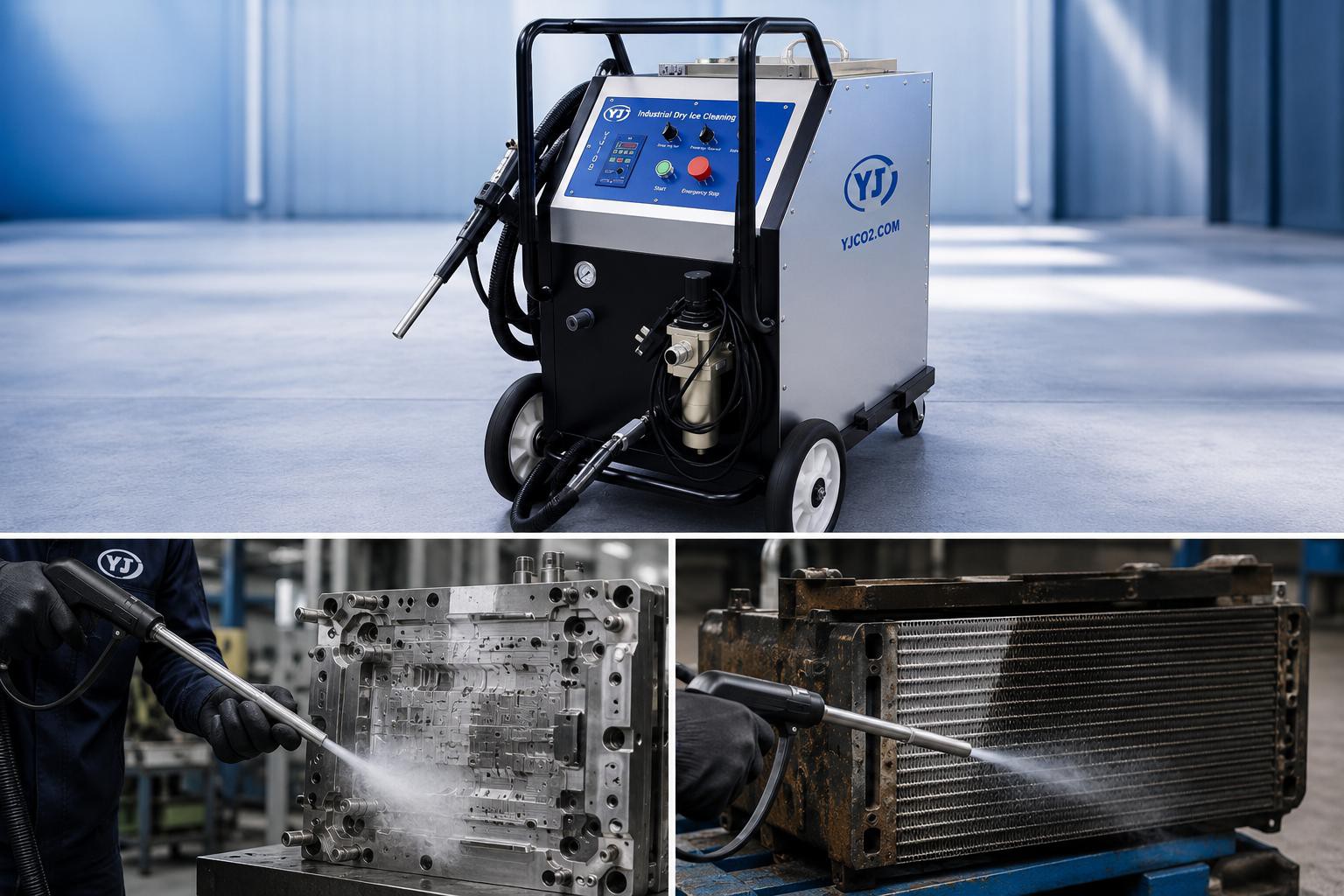
Premium vs. Budget Dry Ice Blasters: The Difference Is Not Just Price
A premium dry ice blaster is not simply a more expensive machine with a better-looking cabinet. In industrial use, "premium" usually means better airflow control, more stable dry ice feeding, stronger components, better nozzle options, longer service life, and stronger technical support.
A budget dry ice blaster usually focuses on the basic function: it can feed dry ice, mix it with compressed air, and blast it onto a surface. For occasional cleaning, that may be enough. For example, a small workshop cleaning light oil from metal fixtures once or twice a week may not need a heavy-duty industrial system.
But once the job becomes more demanding, the gap becomes clear.
Cleaning tire molds with deep tread patterns, removing thick adhesive residue from equipment, cleaning food machinery without water, or running a dry ice blasting service business are not the same as cleaning a flat metal plate for a short test. In those situations, output stability matters more than the lowest purchase price.
Premium and budget should not be defined by country of origin. They should be defined by engineering design, component quality, dry ice feeding stability, airflow control, testing support, and service capability.
A low-cost machine can work. A poorly matched machine becomes expensive very quickly.
How Machine Quality Affects Dry Ice Blasting Performance
Dry ice blasting works through three main actions.
First, the dry ice pellets hit the contaminant at high speed. This impact helps break loose oil, carbon, resin, rubber residue, adhesive, paint, or mold release buildup.
Second, dry ice is extremely cold, around -78.5°C. When it touches the contaminant layer, the rapid cooling can make the dirt brittle and easier to separate from the base surface.
Third, the dry ice sublimates into CO₂ gas. As it changes from solid to gas, it expands and helps lift loosened contamination from the surface.
That sounds simple, but the machine has to control the process well.
A dry ice blaster does not clean better just because the pressure number looks high on a specification sheet. The machine must keep dry ice pellets moving smoothly, mix air and ice efficiently, maintain stable flow, and deliver the right blasting pattern through the hose and nozzle.
This is where premium and budget machines start to separate.
A budget machine may perform well during a short demonstration, then become less stable during continuous use. The operator may see uneven ice feeding, weak blasting, wasted pellets, or clogging inside the system. The cleaning task still gets done, but it takes longer and consumes more dry ice.
A premium machine is built to make the process more repeatable. It does not just blast harder. It gives the operator better control.
For industrial cleaning, repeatability is not a luxury. It is the difference between a smooth maintenance job and a cleaning process that keeps interrupting production.
Key Differences Between Premium and Budget Dry Ice Blasters
The most useful way to compare machines is not by brand name alone. Compare the parts of the system that affect real cleaning work.
|
Comparison Factor |
Budget Dry Ice Blaster |
Premium Dry Ice Blaster |
|
Purchase price |
Lower upfront cost |
Higher initial investment |
|
Airflow stability |
May fluctuate during longer use |
More stable output under continuous work |
|
Dry ice feeding |
Basic feeding control |
More accurate and consistent feeding |
|
Ice consumption |
Often higher in difficult jobs |
Better ice efficiency when properly matched |
|
Nozzle options |
Limited or basic |
Wider nozzle choices for different applications |
|
Durability |
Suitable for lighter use |
Better for industrial and frequent use |
|
Maintenance |
More sensitive to wear and clogging |
Easier to service, stronger components |
|
Best fit |
Light-duty, occasional cleaning |
Continuous, precision, or high-value cleaning |
Airflow and Pressure Stability
Dry ice blasting depends on compressed air. Most industrial machines need both enough pressure and enough air volume. Many dry ice blasting applications require clean compressed air above roughly 4.5 bar and several cubic meters per minute of flow, depending on the machine, hose length, nozzle, and cleaning task.
Pressure alone does not tell the full story.
A machine may advertise high pressure, but if airflow drops during operation, the blasting stream becomes unstable. The operator then moves slower, repeats the same area, uses more dry ice, and still may not get a clean result.
Budget machines are more likely to show this problem during longer jobs. They may be acceptable for short spot cleaning but struggle when used continuously on heavy grease, carbon deposits, thick coatings, or adhesive residue.
Premium machines usually have better air path design, stronger valves, and more stable output control. This matters in mold cleaning, automotive part cleaning, and production line maintenance, where inconsistent blasting means inconsistent cleaning.
For industrial cleaning, stable airflow is usually more valuable than a high number on the specification sheet.
Dry Ice Feeding Control
Dry ice feeding is one of the biggest differences between an entry-level machine and a better industrial dry ice blaster.
The machine has to feed pellets at a controlled rate. If the feeding is too low, the cleaning is weak. If it is too high, dry ice is wasted. If the feeding is uneven, the operator feels it immediately: strong blast, weak blast, strong blast again.
That is not good cleaning. That is guesswork.
Budget machines may use simpler feeding structures. For light work, this can be acceptable. But with long operating hours or smaller pellet sizes, problems like bridging, clogging, pellet breakage, or uneven delivery become more common.
Premium machines are usually designed for smoother dry ice flow and finer adjustment. This helps when cleaning sensitive surfaces, such as electronic equipment, precision molds, or food processing machinery. The operator can reduce feed rate and pressure for delicate surfaces, then increase output for tougher deposits.
Dry ice is a consumable. Poor feeding control wastes money every hour the machine runs.
Nozzle, Hose, and Blast Gun Design
Many buyers focus on the main machine and ignore the nozzle, hose, and blast gun. That is a mistake.
The nozzle controls the shape of the blasting stream. A narrow nozzle gives focused impact for grooves, corners, mold details, and stubborn deposits. A wider nozzle covers more area and works better for large equipment surfaces, conveyors, and production line cleaning.
The hose also matters. A longer hose gives more working distance, but it can reduce pellet speed and increase flow loss if the system is not designed well. Hose diameter, bending, internal surface quality, and connection design all affect how smoothly dry ice travels from the machine to the nozzle.
Budget machines often come with a basic nozzle package. That may be enough for general cleaning, but not for varied industrial work.
Premium machines are usually sold as a system: machine, hose, gun, nozzles, and application guidance. That system approach is more useful than simply buying a machine with a low price tag.
If the nozzle is wrong, even a powerful machine can clean poorly.
Component Quality, Durability, and Service Life
A dry ice blaster works in a harsh environment. It handles cold pellets, compressed air, vibration, moisture risk, dust, and sometimes long daily operation. The parts inside the machine matter.
Pay attention to:
- Valves and seals
- Dry ice feeding parts
- Air control components
- Electrical control system
- Hopper structure
- Hose fittings
- Frame and wheel design
- Accessibility for maintenance
A budget dry ice blaster can make sense when used occasionally. But if the machine is used every day in a factory or taken from site to site by a cleaning service team, wear becomes a real cost.
Premium machines generally use stronger components and better internal layouts. They are easier to service, more stable during longer use, and better suited to industrial cleaning schedules.
A machine that saves money on day one but fails during a shutdown window can become the most expensive choice in the workshop.
Total Cost of Ownership: Why the Cheapest Machine May Not Be the Lowest-Cost Choice
Purchase price is only the first number.
The real cost of a dry ice blasting machine includes dry ice, compressed air, labor time, maintenance, spare parts, training, and downtime. For frequent users, those costs can exceed the price difference between machines.
Dry Ice Consumption and Dry Ice Supply
Dry ice pellets are consumed every time the machine runs. A machine with poor feeding control or weak blasting efficiency may use more pellets to clean the same surface.
For example, if two machines clean the same mold, but one needs 40 minutes and the other needs 25 minutes, the difference is not only labor time. It is also dry ice, compressed air, and production downtime.
Dry ice supply also matters. Buyers should check:
- Is dry ice available locally?
- Are 3 mm pellets easy to source?
- How much dry ice is lost during storage and transport?
- Does pellet quality stay consistent?
- Can the supplier support long cleaning jobs or urgent orders?
A dry ice blaster that wastes pellets will feel cheap only before it is used regularly.
Compressed Air Demand
Dry ice blasters need compressed air to accelerate the pellets. Without enough air volume, the machine cannot perform well.
This is one of the most common buying mistakes.
A customer may buy a stronger machine, connect it to a weak compressor, and then blame the machine for poor cleaning. In reality, the airflow is not enough. Pressure, flow rate, air dryness, pipe size, and distance from the compressor all matter.
Before buying, check both pressure and flow. Do not only ask, "How many bar or PSI?" Ask how much air volume the machine needs under real use.
Clean, dry, stable compressed air protects the machine and improves cleaning consistency.
Downtime, Labor, and Maintenance
A low-priced machine may still be expensive if it slows down the job.
In a factory, cleaning is often done during limited maintenance windows. If a machine clogs, loses output, or needs repeated adjustment, the cleaning team loses time. If production cannot restart on schedule, the cost is far higher than the price difference between two machines.
For service companies, the calculation is even clearer. A dry ice blasting service business earns money by completing work on-site. A machine that wastes ice, breaks down, or cleans slowly reduces profit on every project.
The more often the machine runs, the more important reliability becomes.
When a Budget Dry Ice Blaster May Be Enough
A budget dry ice blaster is not always a bad choice. It depends on risk, cleaning frequency, and required result.
Occasional or Light-Duty Cleaning
If the machine is used for occasional maintenance, light oil, dust, simple surface dirt, or non-critical equipment cleaning, a budget model may be enough.
For example, a small workshop that cleans machine covers, metal fixtures, or general maintenance parts once in a while may not need a high-end industrial system. The cleaning target is simple. The surface is not highly sensitive. The work schedule is flexible.
In that case, lower upfront cost can make sense.
Small Workshops or First-Time Users
Budget machines can also be useful for first-time users who want to test dry ice blasting before investing in a larger system.
Automotive detailing shops, small repair workshops, and new cleaning service businesses may start with an entry-level machine to understand the market. This is reasonable if they accept the limits.
The buyer still needs to confirm four things before ordering:
- The compressor can supply enough air
- Dry ice pellets are available locally
- Spare parts are easy to get
- The machine comes with basic training or support
Cheap equipment without support is not a starter machine. It is a risk.
Simple Contaminants and Low-Risk Surfaces
Budget machines are most suitable when the contaminant is easy to remove and the surface is not expensive, delicate, or production-critical.
Light grease on a metal frame is very different from residue inside a precision mold. Surface dust on a machine cover is different from carbon deposits on engine parts. A simple flat surface is different from a tire mold with deep patterns.
If the cleaning job is low-risk, a budget dry ice blaster may be acceptable. If the surface is valuable or the cleaning result affects product quality, do not make price the first filter.
When a Premium Dry Ice Blaster Is Worth the Investment
Premium dry ice blasters make sense when poor cleaning has a real cost.
Continuous Industrial Cleaning
Factories that clean daily or weekly should give more weight to stability than purchase price.
If a dry ice blaster is used for production line maintenance, mold cleaning, equipment cleaning, or multi-shift operation, it must run reliably. It should feed dry ice evenly, keep airflow stable, and handle repeated use without frequent downtime.
In these settings, premium or industrial-grade machines usually pay for themselves through fewer interruptions, faster cleaning, better ice efficiency, and longer service life.
The more expensive your downtime is, the less sense it makes to gamble on the cheapest machine.
Mold, Tire Mold, and Precision Cleaning
Mold cleaning is one of the clearest cases where machine quality matters.
Plastic molds, rubber molds, tire molds, and precision tooling often need cleaning without damaging surfaces, edges, vents, or texture. Traditional scraping, sanding, or chemical cleaning can damage the mold or require disassembly. Dry ice blasting can clean in place, but only if the machine is controllable.
A premium machine gives the operator more room to adjust pressure, feed rate, nozzle type, and cleaning distance. That helps clean fine mold details without being too aggressive.
Tire mold cleaning is a good example. The contamination often includes rubber residue, mold release agents, carbon black, and additives trapped in narrow tread patterns. A weak or unstable machine may clean the visible areas but leave buildup in fine details. A better machine with the right nozzle can clean more evenly and reduce manual rework.
Food, Electronics, and Sensitive Equipment
Food processing equipment often cannot tolerate water residue, chemical residue, or long disassembly. Dry ice blasting is useful because it is dry and leaves no blasting media behind.
But food equipment also demands control. The wrong pressure, wrong nozzle, or poor operator training can create problems. A premium dry ice blaster with stable output and proper application support is safer for this type of work.
Electronics and sensitive equipment have a similar requirement. Dry ice blasting can be used at lower pressure for certain electrical or precision cleaning tasks, but the machine must allow controlled adjustment. A rough, unstable blasting stream is not suitable for delicate surfaces.
Sensitive cleaning does not always need maximum power. It needs control.
Heavy Contaminants and Cleaning Service Businesses
Adhesive residue, resin, carbon deposits, rubber residue, thick grease, ink buildup, and baked-on contamination all demand more from the machine.
A budget machine may remove some of it, but often slowly. The operator may spend too much time on one area, use too much dry ice, or need manual scraping afterward.
For cleaning service businesses, this becomes a profit problem. If your team is paid to clean molds, factory equipment, automotive parts, or production machinery at a customer site, equipment reliability directly affects your reputation. Frequent clogging, unstable output, or slow cleaning can make a job unprofitable.
A premium dry ice blaster is not required for every business. But if the machine is your main working tool, it should not be the weakest part of your service.
What to Check Before Buying a Dry Ice Blaster
The safest way to choose between a budget, mid-range, and premium dry ice blaster is to start with the application, not the machine price.
Application, Surface, and Contaminant Type
Before asking for a quotation, prepare basic job information:
|
Question |
Why It Matters |
|
What contaminant needs to be removed? |
Oil, grease, carbon, adhesive, resin, paint, mold release, and dust need different settings |
|
What is the base material? |
Steel, aluminum, rubber, plastic, electronics, and mold surfaces react differently |
|
How often will the machine run? |
Occasional cleaning and daily industrial use need different machine classes |
|
Can the equipment be stopped or disassembled? |
In-place cleaning needs better access, nozzle selection, and operator control |
|
What cleaning result is acceptable? |
Rough cleaning and precision cleaning are not the same job |
A supplier cannot recommend the right dry ice blasting machine without understanding these points.
Air Compressor Compatibility
Ask for the required air pressure and air volume under real working conditions. Then compare that with your existing compressor.
Do not rely only on the pressure rating. A compressor may reach the required pressure but fail to maintain enough flow. Long air pipes, small pipe diameter, moisture, and pressure loss can also reduce blasting performance.
If your compressed air system is weak, upgrading the machine alone will not solve the problem.
Supplier Testing, Customization, and Support
A good supplier should help you choose the right configuration, not just send a price list.
Ask these questions before buying:
- Can you test my actual contaminant or sample?
- What nozzle do you recommend for this cleaning task?
- What dry ice consumption should I expect?
- What air compressor capacity does this model require?
- Can the machine run continuously for my working hours?
- What spare parts are normally replaced?
- Do you provide operation training?
- Can you customize voltage, plug, language, hose length, nozzle package, or machine layout?
- Do you support OEM, ODM, or automated dry ice cleaning systems?
These questions quickly show whether the supplier understands applications or only sells equipment.
Final Recommendation: Choose by Application, Not by Price Tag
Budget dry ice blasters are suitable for simple, low-frequency, low-risk cleaning. Premium dry ice blasters are better for continuous industrial work, mold cleaning, food equipment, electronics, heavy contaminants, and cleaning service businesses.
There is also a middle ground. Some buyers do not need the most expensive system, but they do need better stability, better feeding control, and reliable support. For many factories, a well-matched mid-range or industrial-grade machine is the practical choice.
The best dry ice blaster is not the cheapest one or the most expensive one. It is the one that matches your contaminant, surface, working hours, compressor, dry ice supply, and cleaning standard.
YJCO2 manufactures portable, industrial, automatic, and customized dry ice blasting machines for different cleaning applications. If you are not sure which machine class fits your job, send us your contaminant type, cleaning surface, working hours, and compressed air conditions. Our team can help evaluate the right configuration before you invest.