A treadmill, weight machine, dumbbell rack, or cable station is touched hundreds of times a day. Sweat, body oil, dust, chalk powder, rubber particles, drink spills, and airborne dirt collect on the surface first. Then they move into seams, screw holes, guide rails, textured handles, ventilation grilles, and machine bases.
Daily wiping is necessary, but daily wiping is not deep cleaning.
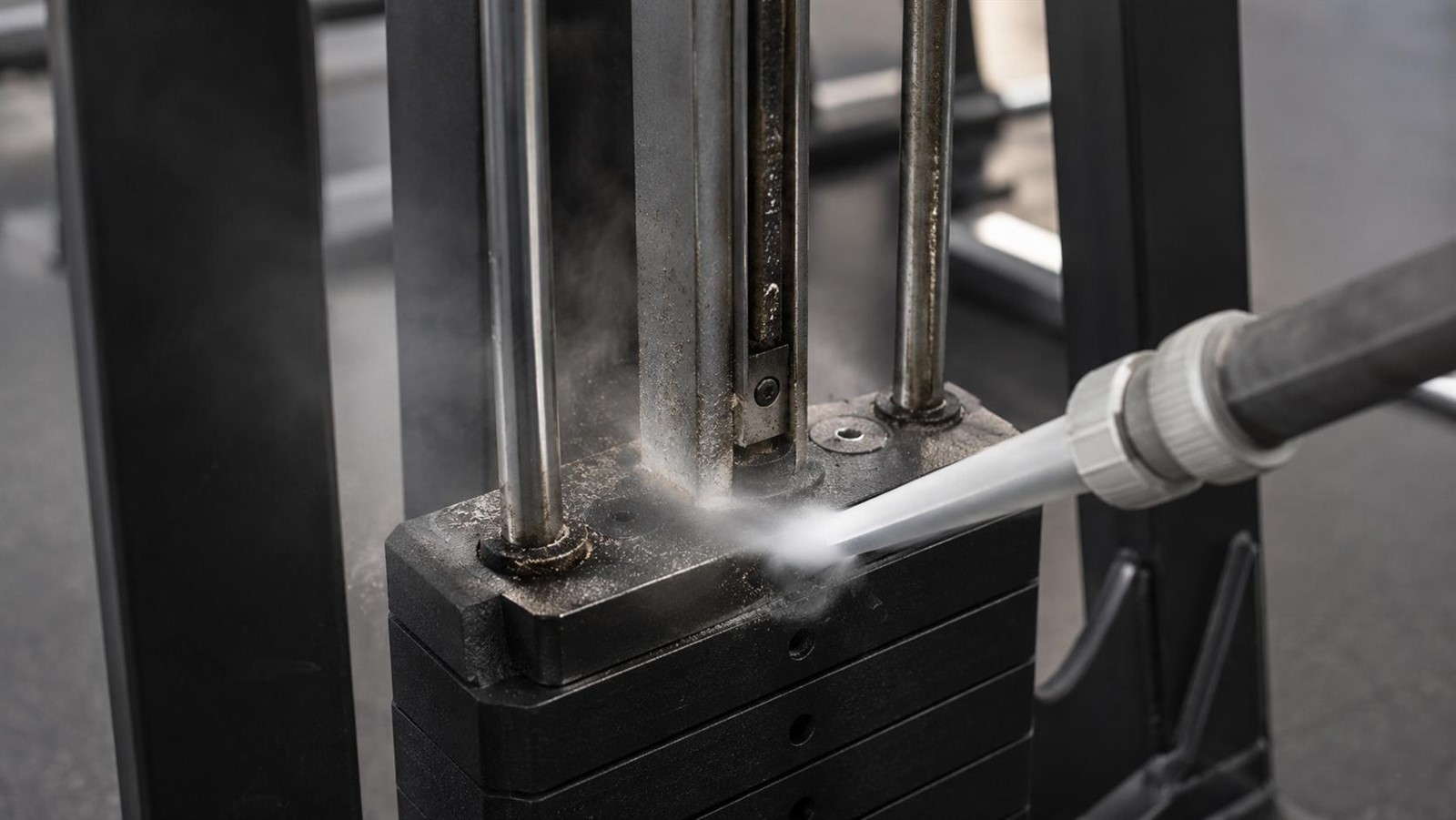
Dry ice cleaning is a method that uses compressed air to blast solid CO₂ particles onto equipment surfaces. The dry ice removes dirt, grease, sweat residue, dust buildup, and other contaminants without adding water, abrasive media, or chemical residue.
For commercial gyms, sports facilities, hotel gyms, and cleaning contractors, this makes dry ice blasting a practical option for scheduled deep cleaning. It is not a replacement for daily sanitation. It is a deeper maintenance method for areas that cloths, mops, sprays, and brushes do not handle well.
Why Gym Equipment Needs More Than Daily Wiping
Most gyms already have a daily cleaning routine. Staff wipe down handles, seats, touch screens, benches, and visible surfaces. Members may also be asked to clean equipment after use.
That solves part of the problem.
The harder problem is what builds up over time.
On strength machines, sweat and dust collect around weight stacks, guide rods, pulleys, frame joints, and cable openings. On cardio equipment, fine dust settles near motor covers, fan vents, pedals, textured foot areas, and machine bases. In free weight zones, chalk powder, skin oil, metal dust, and rubber particles accumulate around dumbbell racks, plate trees, kettlebell storage, and floor edges.
These are not surfaces that a staff member can clean well with a towel during operating hours.
Water-based cleaning creates another problem. Many gym machines have bearings, coated metal parts, motors, electronic controls, sensors, and hidden cavities. High-pressure water or steam may be useful for selected floors, but it is a poor match for most indoor fitness equipment.
Chemical cleaning also has limits. Disinfectants are needed for hygiene control, but they do not always remove thick dirt buildup in corners and mechanical structures. Some leave odor. Some require contact time. Some may affect rubber, plastic, paint, labels, or upholstery if used too aggressively.
This is where gym equipment deep cleaning becomes a separate job from daily cleaning.
A good deep-cleaning method should reach narrow areas, avoid soaking the machine, reduce chemical residue, and protect the equipment surface. Dry ice cleaning fits that role better than many traditional methods.
How Dry Ice Cleaning Works
Dry ice cleaning, also called dry ice blasting or CO₂ cleaning, uses compressed air to accelerate dry ice particles toward a surface. Dry ice is solid carbon dioxide at about -78.5°C. When it hits the surface, it does not melt into liquid. It sublimates, which means it changes directly from solid to gas.
The cleaning effect comes from three actions working together.
Impact Force
The first action is impact.
Dry ice particles are carried by compressed air through a hose and nozzle. When the particles strike dirt, grease, or buildup on a machine surface, they help break the bond between the contaminant and the base material.
This is not the same as sandblasting.
Sand, glass bead, steel shot, and other abrasive media remove material by cutting or wearing down the surface. Dry ice is much softer and disappears after impact. That is why dry ice blasting is often used where the goal is to remove contamination without grinding the surface underneath.
For gym equipment, this matters. You are usually not trying to strip metal. You are trying to remove sweat residue, dust, oil film, grime, and buildup from frames, rails, racks, and textured surfaces.
Thermal Shock
The second action is thermal shock.
When dry ice at -78.5°C hits dirt or oily residue, the contaminant cools very quickly. Many residues become brittle, shrink, or crack under this sudden temperature change. Once the contaminant loses its grip on the surface, the air stream and particle impact can remove it more easily.
This is useful for mixed gym contamination. Sweat residue, body oil, chalk dust, rubber particles, and dust can form a stubborn layer after months of use. Manual wiping often spreads this layer around instead of fully removing it from edges and seams.
Thermal shock helps break that layer loose.
Sublimation Without Water Residue
The third action is sublimation.
After impact, dry ice turns into CO₂ gas. The gas expands rapidly, often described as roughly 800 times the volume of the solid dry ice. This expansion helps lift loosened contaminants from small gaps, surface texture, and narrow corners.
The key point is simple: dry ice does not leave water behind.
It also does not leave sand, grit, or blasting media. After cleaning, the remaining material is mainly the dirt that was removed from the equipment.
That dirt still needs to be collected.
This is an area where some explanations become too loose. Dry ice cleaning is not "no cleanup." It is no water, no chemical liquid, and no blasting media residue. Removed dust, grease, and debris still need to be vacuumed, wiped, or collected after the job.
Where Dry Ice Cleaning Works Best in Gyms
Dry ice cleaning is not for every surface in a gym. It works best on hard surfaces, complex equipment structures, and areas where water or chemical residue is a concern.
Strength Training Machines
Strength machines are one of the best gym applications for dry ice blasting.
A selectorized weight machine has many areas that collect dirt:
- Metal frames
- Weight stacks
- Guide rods
- Cable openings
- Pulley brackets
- Machine bases
- Bolts, seams, and joints
- Handle brackets and adjustment holes
These areas are difficult to clean by hand because access is poor. They are also not ideal for water washing because moisture can move into metal joints, guide systems, or bearing areas.
Dry ice cleaning can remove buildup from these structures while reducing the need for disassembly. For a large commercial gym with 30–80 strength machines, that can make deep cleaning more realistic during closed hours.
The point is not to make every machine look new in one pass. The point is to remove the layer of dirt that normal wiping never reaches.
Cardio Equipment Frames and Bases
Cardio machines are more sensitive.
Treadmills, ellipticals, rowing machines, stair climbers, and indoor bikes often contain motors, sensors, screens, control panels, plastic covers, fans, and wiring. That does not mean dry ice cleaning cannot be used around them. It means the operator must choose the right areas.
Better targets include:
- Machine frames
- Bases and lower covers
- Pedal structures
- Textured hard surfaces
- Fan grille areas
- Dust buildup around non-sensitive housings
- External mechanical structures
Areas that need protection include touch screens, control panels, exposed sensors, damaged seals, and open electrical parts.
A controlled dry ice cleaning process can help remove dust and grime from cardio equipment without soaking the machine. But direct blasting on screens or electronics is poor practice. The right method is testing, shielding, distance control, and lower pressure where needed.
Free Weight and Storage Areas
Free weight zones often look clean from a distance but collect heavy residue.
Dumbbell racks, barbell racks, plate trees, kettlebell storage, and bench frames are exposed to sweat, chalk, metal dust, floor dust, and rubber particles. These surfaces are touched often and cleaned unevenly.
Dry ice blasting can be useful here because the surfaces are usually hard and durable. It can clean the edges, rack slots, support frames, and underside areas that staff rarely reach during daily cleaning.
This also improves visual quality. A clean free weight zone affects how members judge the entire facility.
Lockers, Vents, and Hard Facility Surfaces
Dry ice cleaning can also be used on selected facility surfaces, especially where dust and grime collect in hard-to-reach areas.
Examples include:
- Metal lockers
- Ventilation grilles
- Hard wall edges
- Equipment bases near walls
- Rubber flooring in selected areas, after testing
- Storage racks and maintenance areas
It is better to be selective.
Yoga mats, foam rollers, battle ropes, mirrors, shower areas, and soft upholstery are not the first places to apply dry ice blasting. Some may be cleaned in special cases, but they require material testing and are often better handled with other cleaning methods.
A gym cleaning plan should not force one method onto every surface. Dry ice blasting is strongest when used where its advantages are clear: hard surfaces, narrow gaps, complex structures, and areas where water is a risk.
Dry Ice Cleaning vs. Traditional Gym Cleaning Methods
Dry ice cleaning is not a magic replacement for every cleaning method in a gym. It fills a specific gap between daily surface cleaning and heavy industrial cleaning.
|
Cleaning Method |
Best Use in Gyms |
Main Limitation |
|
Manual wiping |
Daily touch-point cleaning on handles, seats, benches, and controls |
Cannot reach deep gaps, rails, bases, and old buildup |
|
Chemical cleaning |
Sanitizing, disinfection, and routine hygiene control |
Odor, residue, contact time, and material compatibility concerns |
|
Steam / pressure washing |
Selected floors, outdoor areas, and some hard surfaces |
Moisture risk around equipment, motors, bearings, and electronics |
|
Abrasive blasting |
Heavy rust or coating removal in industrial settings |
Too aggressive for most gym equipment |
|
Dry ice cleaning |
Deep cleaning of frames, racks, vents, bases, rails, and hard-to-reach areas |
Requires equipment, training, ventilation, and dry ice supply |
Manual wiping still has a place. It should remain part of daily gym operations because members touch equipment constantly.
Chemical disinfectants also have a place. When disinfection is required, a gym should follow local health rules and approved disinfectant procedures.
Dry ice cleaning serves another purpose. It removes the dirt and buildup that make equipment harder to maintain over time. It is especially useful before or alongside a scheduled maintenance program.
A practical gym cleaning system is usually layered: daily wiping for touch points, approved disinfectants where required, and scheduled dry ice deep cleaning for frames, racks, gaps, vents, and mechanical structures.
Is Dry Ice Cleaning Safe for Gym Equipment?
Dry ice cleaning can be safe for many gym equipment surfaces, but safety depends on the material, machine settings, nozzle choice, spray distance, and operator skill.
The machine is only one part of the result.
A strong machine used carelessly can damage sensitive parts. A properly adjusted machine can clean many surfaces with good control.
Materials Usually Suitable for Dry Ice Cleaning
Dry ice blasting is usually a good fit for hard, durable equipment surfaces such as:
- Powder-coated metal frames
- Stainless steel structures
- Machine bases
- Dumbbell and barbell racks
- Weight stacks and guide rods
- Hard plastic covers, after testing
- Ventilation grilles
- Selected rubber flooring, after testing
On these surfaces, the non-abrasive nature of dry ice gives it an advantage over sand, grit, or aggressive mechanical brushing. It can remove contamination without grinding the base material.
That does not mean every coated surface is safe at every pressure. Old paint, weak coatings, damaged labels, or brittle plastic can still be affected by poor settings.
A small test area is always the right first step.
Areas That Need Extra Care
Some gym equipment areas should be protected, avoided, or cleaned only with lower pressure and careful testing:
- Touch screens
- Control panels
- Sensors
- Exposed wiring
- Open motor areas
- Old rubber grips
- PU or leather upholstery
- Decals, printed logos, and labels
- Soft training accessories
This is where operator experience matters.
A trained operator will adjust pressure, ice feed rate, nozzle angle, and distance. They will also decide when not to blast a surface. That judgment is more valuable than raw machine power.
For example, a weight stack frame may handle dry ice cleaning well, while the printed instruction label on the same machine should be avoided. A treadmill base may be cleaned, while the touch screen should be covered.
Cleaning Is Not the Same as Disinfection
This point needs to be clear.
Dry ice cleaning removes dirt, grease, sweat residue, dust, and buildup. It can create a cleaner surface before disinfection. But it should not be presented as a full replacement for required gym disinfection.
The low temperature and cleaning action may help remove some biological residue from surfaces, but a gym should not depend on dry ice blasting alone for hygiene compliance. If local rules or facility standards require disinfectants, use approved disinfectants after cleaning.
This distinction makes the cleaning plan stronger, not weaker.
Dry ice cleaning handles buildup. Disinfection handles hygiene requirements. They can work together.
How to Use Dry Ice Cleaning in a Gym Cleaning Plan
Dry ice cleaning works best when it is planned as scheduled deep cleaning, not as a daily cleaning substitute.
For a large commercial gym, dry ice cleaning may be considered monthly, quarterly, or during major maintenance windows. For a smaller gym or boutique studio, hiring a service contractor may make more sense than buying equipment. For a commercial cleaning company, a dry ice blaster can become a higher-value service for gyms, sports centers, hotel fitness rooms, and university training facilities.
The frequency depends on traffic, equipment quantity, cleaning standards, and contamination level.
A gym with 1,000–2,000 visits per day and heavy free weight use will need a different schedule from a small private training studio.
Before cleaning, the site should be prepared properly:
- Identify sensitive parts such as screens, sensors, labels, and soft pads
- Cover or avoid areas that should not be blasted
- Test a small area before full cleaning
- Check ventilation, especially in enclosed rooms
- Schedule work during closed hours or low-traffic periods
- Use eye protection, cold-resistant gloves, and hearing protection
- Plan how removed dirt and debris will be collected
Ventilation matters because dry ice becomes CO₂ gas. CO₂ is not flammable, but it can displace oxygen in poorly ventilated spaces. Basements, small studios, enclosed equipment rooms, and locker areas need more attention than open gym floors.
Noise also matters. Dry ice blasting uses compressed air and can be loud. It should not be done around members during normal training unless the area is isolated.
After cleaning, the removed dust, grease, and debris should be collected. Then the gym can apply required disinfectants where needed.
The best workflow is simple: inspect, test, protect sensitive areas, clean, collect debris, then disinfect where required.
Choosing the Right Dry Ice Cleaning Machine for Gym Applications
For gym applications, the right dry ice cleaning machine is not always the most powerful machine.
A gym has narrow aisles, mixed materials, sensitive equipment, and many small areas. Control matters more than maximum blasting force.
Portability and Easy Movement
A portable dry ice cleaning machine is usually a better fit for gyms than a large stationary system.
The machine must move between cardio zones, strength areas, free weight sections, locker areas, and storage spaces. Operators may need to work around tight machine layouts and narrow walkways.
A compact machine, stable wheels, practical hose length, and easy control panel make the job faster and safer.
Adjustable Pressure and Ice Feed Rate
Gym equipment varies widely. A heavy steel rack, a coated machine frame, a hard plastic cover, and a rubber floor section should not all be cleaned with the same settings.
A good dry ice blaster for gyms should allow adjustment of:
- Air pressure
- Ice feed rate
- Spray pattern
- Nozzle type
- Cleaning intensity
Lower pressure and controlled ice feed are useful around coated surfaces, plastic covers, and tight equipment structures. Higher output may be used for durable metal frames, racks, and heavy buildup.
The goal is not to blast harder. The goal is to clean with control.
Nozzle, Hose, and Air Supply Requirements
Nozzle choice affects real cleaning performance.
Wide nozzles are useful for frames, racks, and larger hard surfaces. Narrow nozzles are better for seams, guide rails, corners, and ventilation grilles. Some gym work requires switching between nozzles often.
Hose configuration also matters. A hose that is too short slows the job down. A hose that is too long may reduce efficiency if the system is not matched correctly.
Compressed air is another key factor. Many dry ice blasting systems require stable compressed air to perform well. Depending on the machine and cleaning intensity, the air supply may need to support industrial-level flow and pressure. A buyer should check compressor capacity before choosing equipment.
This is where many first-time buyers make mistakes. They compare machine prices but ignore the air system, nozzles, dry ice consumption, and operator training.
Supplier Support and Application Testing
For gym cleaning, supplier support is not optional.
A good supplier should help answer practical questions:
- Which machine size fits the cleaning workload?
- What pressure range should be tested first?
- Which nozzles are suitable for weight machines, racks, and vents?
- How much dry ice is likely to be consumed per cleaning session?
- What air compressor capacity is required?
- Which surfaces should be avoided?
- What training does the operator need?
This matters more than a brochure specification.
YJCO2 manufactures portable, industrial, and customized dry ice cleaning equipment for different cleaning workloads. For gym cleaning service providers, large fitness facilities, or maintenance teams, the right setup should be selected based on equipment type, cleaning frequency, air supply, nozzle needs, and operator skill.
A dry ice blaster should solve the cleaning problem on site, not just look good in a product catalog.

A Practical Deep-Cleaning Option for Modern Gyms
Dry ice cleaning is a strong option for gyms when it is used for the right job.
It is best for scheduled deep cleaning of fitness equipment frames, weight stacks, rails, racks, machine bases, ventilation grilles, lockers, and other hard-to-reach surfaces. It helps remove sweat residue, grease, dust, chalk, rubber particles, and built-up dirt without adding water or chemical liquid to the equipment.
It should not replace daily wiping. It should not be sold as a complete disinfection method. A serious gym cleaning plan still needs daily surface cleaning and approved disinfectants where required.
For commercial gyms, sports facilities, and cleaning contractors, dry ice cleaning can improve deep-cleaning efficiency, reduce moisture risk, and protect equipment better than aggressive washing or abrasive methods.
If you are planning to add dry ice cleaning to your gym maintenance work or commercial cleaning service, YJCO2 can help evaluate the right dry ice blasting machine, nozzle setup, air supply requirement, and application parameters for your cleaning needs. Contact us to discuss your equipment and cleaning scenario.