


Adhesive residue on production equipment is not the same as a label stuck on a glass jar.
On machinery, adhesive often mixes with oil, dust, paper fibers, rubber particles, resin, wax, or process debris. After heat, pressure, and repeated production cycles, it becomes harder to remove. The wrong cleaning method may leave scratched metal, solvent residue, moisture inside the machine, or extra downtime.
Dry ice blasting is one practical way to remove adhesive from industrial equipment when the surface cannot tolerate water, harsh solvents, or abrasive media.
It is not suitable for every glue. But for adhesive residue on molds, rollers, conveyors, fixtures, packaging machines, and production tools, it is often one of the cleaner methods to test first.
Can Dry Ice Blasting Remove Adhesive from Equipment?
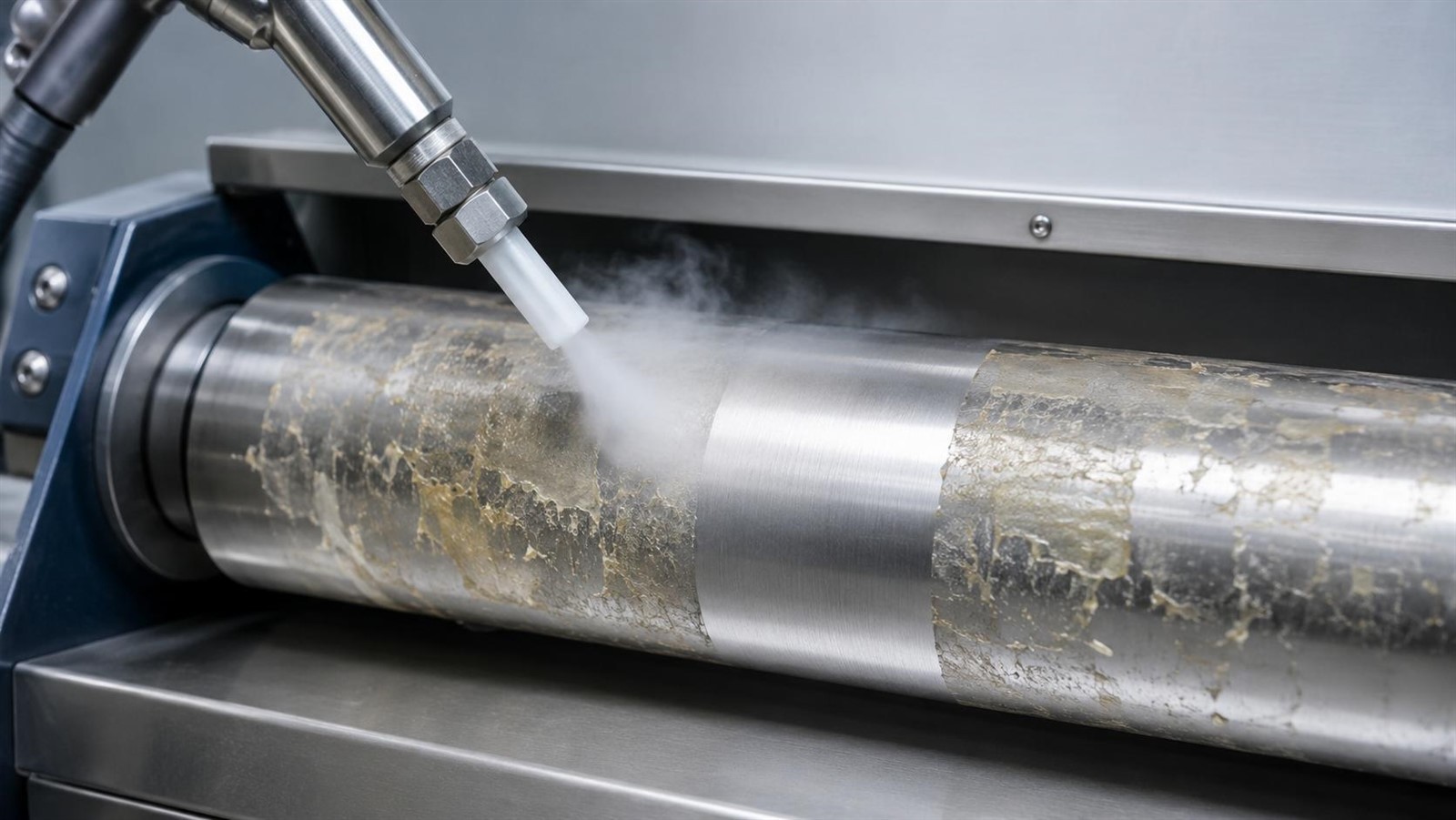
Yes. Dry ice blasting can remove many types of adhesive residue from industrial equipment, especially dried glue, tape residue, label adhesive, resin buildup, wax, release agents, and sticky production deposits.
Dry ice blasting is an industrial cleaning process that uses compressed air to accelerate solid CO₂ pellets onto a contaminated surface. These pellets are extremely cold, about -78.5°C, and they turn directly from solid into gas after impact. This process is called sublimation.
For adhesive removal, dry ice does not work like a chemical remover.
It does not dissolve the glue. It weakens the bond between the adhesive and the equipment surface.
The cleaning effect comes from three actions: thermal shock, kinetic impact, and CO₂ sublimation. The adhesive becomes brittle, cracks, and lifts away from the surface. Since the dry ice becomes gas, it does not leave blasting media behind.
This is why dry ice blasting is useful on equipment that cannot be scratched, soaked, or contaminated by chemical residue. A scraper may remove glue, but it can also cut into a roller surface. A solvent may soften adhesive, but it can leave odor, VOCs, or residue. Dry ice blasting offers a dry, non-abrasive alternative.
The limitation is clear. Fresh soft glue, uncured adhesive, thick elastic sealant, or silicone-like materials may not crack easily under cold impact. These cases need testing, staged cleaning, or partial pre-removal.
Why Adhesive Residue Is Difficult to Remove with Traditional Methods
Industrial adhesive residue is difficult because the residue bonds tightly, collects other contaminants, and often sits on a surface that must stay accurate.
A packaging line may have label adhesive on rollers and guide rails. A mold may have release agent, resin, and rubber residue in fine details. A fixture may hold glue mixed with dust and oil. A conveyor may collect tape residue that hardens after heat and friction.
Traditional cleaning methods can work, but each creates a trade-off.
Chemical solvents can soften adhesive, but they may create odor, VOC exposure, fire risk, waste liquid, and residue. In food processing, electronics, medical components, and precision manufacturing, chemical residue can be a bigger problem than the adhesive itself.
Manual scraping is simple, but it depends heavily on the operator. On polished metal, aluminum, mold steel, coated rollers, and precision fixtures, scraping can create scratches or change the surface finish. Small surface damage can lead to repeat buildup, poor release, or product defects.
High-pressure water can remove some sticky residue, but it introduces moisture. That means drying time, rust risk, wastewater handling, and possible damage near bearings, sensors, motors, or control boxes.
Abrasive blasting has strong removal power, but it may remove more than the adhesive. Sand, soda, glass beads, or plastic media can change surface roughness and leave particles behind. For molds, soft metals, coated surfaces, or tight-tolerance parts, that risk is often unacceptable.
Dry ice blasting is not chosen because it is the strongest method. It is chosen when the cleaning process must remove residue while protecting the equipment surface.
How Dry Ice Blasting Removes Adhesive: The Three-Effect Mechanism
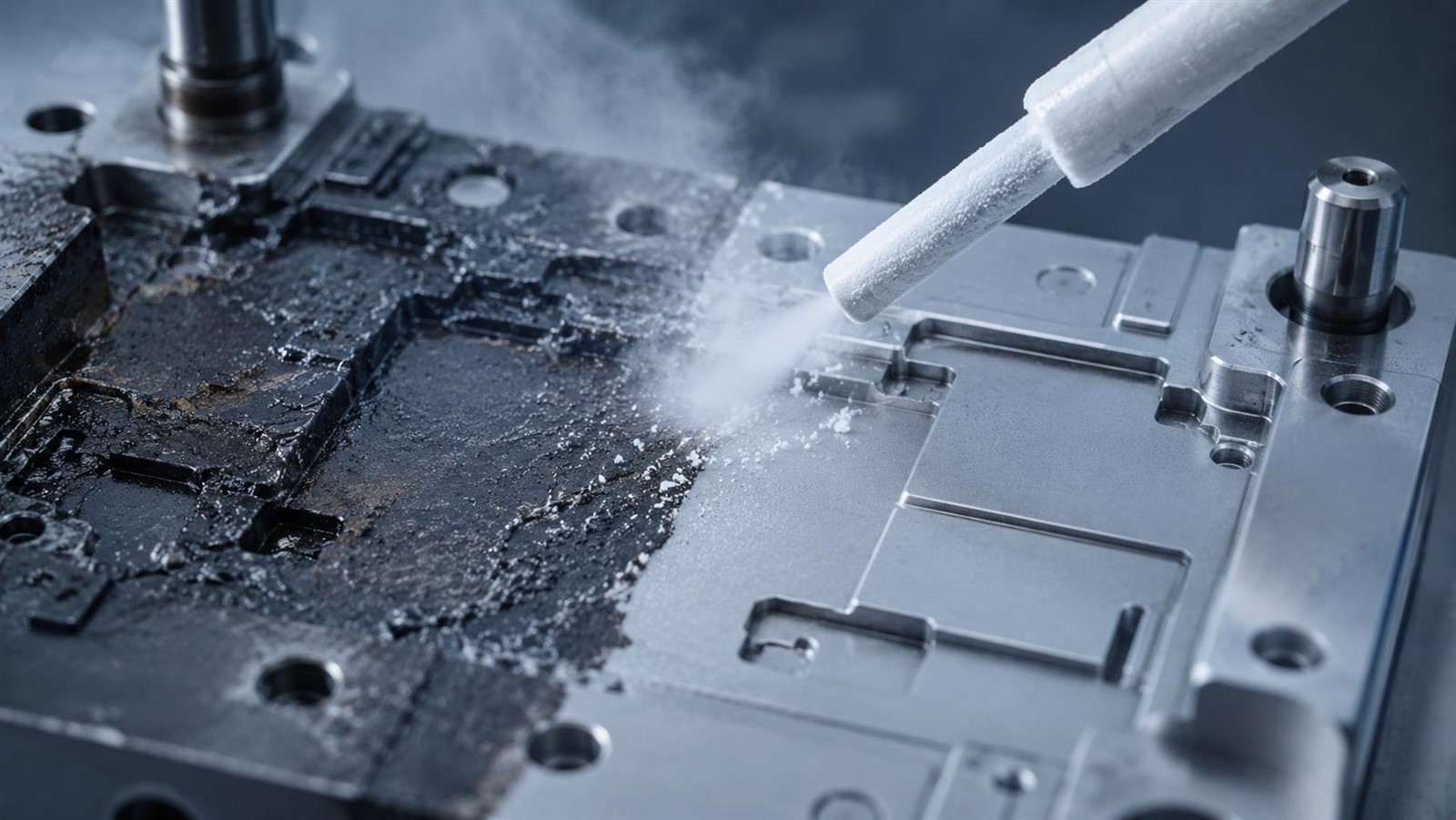
Dry ice blasting removes adhesive through three effects working together.
Thermal Shock Weakens the Adhesive Bond
Many adhesives rely on flexibility and surface contact. When dry ice pellets hit the adhesive layer, the sudden low temperature makes the residue shrink, harden, and become brittle.
That weakens the bond between the adhesive and the equipment surface.
Aged label adhesive on a packaging roller may stretch under a cloth. After cold shock, the same residue can crack and lose its grip. Resin or release agent buildup on a mold can also become easier to separate after rapid cooling.
This is why dry ice blasting often works better on aged, hardened, or contaminated adhesive than on fresh soft glue.
Kinetic Impact Breaks the Brittle Layer
Compressed air accelerates dry ice pellets toward the adhesive. The impact breaks apart the adhesive layer after it has been weakened by cold shock.
This is not the same as sanding. Abrasive blasting cuts or wears the surface. Dry ice blasting mainly breaks the bond between the residue and the base material.
For stubborn adhesive, the operator may need several controlled passes. A single aggressive pass is not always better. Working from the edge of the adhesive layer often gives better peeling results.
CO₂ Sublimation Helps Lift the Residue
After impact, dry ice turns into CO₂ gas. This rapid expansion helps lift residue from small cracks and gaps in the adhesive layer.
The dry ice itself disappears. It does not leave wet slurry, sand, soda powder, or plastic media on the machine.
The removed adhesive still needs to be collected. Glue flakes, resin dust, and other debris remain in the work area. In food, electronics, pharmaceutical, or clean production environments, this collection step should be planned before cleaning starts.
Adhesives and Applications Suited to Dry Ice Blasting
The fit depends on adhesive type, equipment surface, and cleaning goal. The table below gives a practical starting point.
|
Adhesive / Residue Type |
Typical Equipment or Surface |
Suitability |
Notes |
|
Tape residue |
Packaging machines, conveyors, rollers, fixtures |
Good fit |
Best on aged or dust-contaminated residue |
|
Label adhesive |
Labeling machines, food packaging lines |
Good fit |
Useful when water and solvent residue should be avoided |
|
Resin buildup |
Molds, forming tools, production fixtures |
Good fit |
May need repeated passes in corners |
|
Wax and release agents |
Rubber molds, plastic molds, tire molds |
Good fit |
Helps protect mold texture and precision |
|
Glue mixed with oil and dust |
Guide rails, frames, fixtures, workholding tools |
Good fit |
Removed debris still needs collection |
|
Hot melt adhesive |
Packaging equipment, assembly lines |
Needs testing |
Thick layers may need staged removal |
|
Silicone or elastic sealant |
Sealing equipment, assembled components |
Limited |
Elastic material may absorb impact instead of cracking |
|
Fresh soft glue |
Recently applied or uncured adhesive |
Not ideal |
May need curing, scraping, or pre-removal |
|
Adhesive on painted or plastic surfaces |
Painted parts, plastic covers |
Needs testing |
Lower pressure and small-area testing are safer |
|
Adhesive near electrical components |
Assembly tools, control cabinet areas |
Possible with caution |
Dry process helps, but airflow and debris must be controlled |
Dry ice blasting is especially useful on equipment that is cleaned repeatedly. Molds, rollers, packaging lines, fixtures, and forming tools often fall into this category. The value is not only one-time cleaning speed. It is also less surface wear over repeated maintenance cycles.
Step-by-Step Process and Key Parameters
Adhesive removal should start with the residue, not the machine. The same dry ice blaster can produce different results depending on pellet size, air pressure, air volume, nozzle type, spray distance, and operator technique.
Step 1: Inspect the Adhesive and Equipment Surface
Check the adhesive condition first. Is it thin or thick? Old or fresh? Brittle or elastic? Mixed with oil, dust, powder, resin, or paper fibers?
Then check the surface. Stainless steel, mold steel, aluminum, painted surfaces, plastic covers, rubber parts, and coated rollers should not all be cleaned with the same settings.
Look at nearby parts as well. Bearings, sensors, wiring, seals, and open electrical areas may need shielding or a different spray angle.
This inspection decides how aggressive the first test should be.
Step 2: Select Dry Ice Pellet Size and Quality
Dry ice pellets affect impact force and cleaning stability. Many industrial cleaning jobs use 3 mm pellets because they provide a practical balance of impact and feed stability. Smaller particles or softer settings may be better for delicate surfaces, depending on the machine design.
Pellet quality matters. Fresh, dense pellets blast more consistently than old, sublimated pellets. If pellet quality changes, cleaning results change as well.
For factories that clean adhesive frequently, dry ice supply becomes part of the process. Unstable pellet supply can create unstable cleaning performance.
Step 3: Match Air Pressure and Air Volume
Air pressure affects impact strength. Air volume affects how continuously the machine can deliver pellets.
Many dry ice blasting machines need clean compressed air above roughly 4.5 bar and enough flow to operate properly. Adhesive removal should be tested across a practical range, not treated as one fixed pressure setting.
For thick or aged adhesive, higher impact energy may help. For painted surfaces, plastics, and precision parts, start with lower pressure and increase carefully.
Air dryness also matters. Wet compressed air can cause blockage, unstable feeding, or ice formation inside the system.
Step 4: Choose the Right Nozzle, Distance, and Spray Angle
A narrow nozzle concentrates energy and works well on stubborn glue spots or adhesive edges. A wider nozzle is better for thin residue across a larger area.
Spray distance changes cleaning force. Too far away, and the pellets lose impact. Too close, and the working area becomes too narrow or too cold.
For adhesive removal, angle is often more effective than brute force. A shallow angle can help lift the adhesive from the edge. A straight 90-degree blast may only push into the residue without helping it peel away.
Step 5: Use Short Passes and Inspect the Result
Long stationary blasting is usually not the best method. It can overcool one area and waste dry ice.
Use short passes. Check the surface. Adjust.
For stubborn glue, several controlled passes are often better than one aggressive attempt. For plastics, coatings, thin parts, and tight-tolerance surfaces, this also reduces risk.
After blasting, collect loose glue, dust, resin flakes, and other debris. The job is not finished when the dry ice disappears. It is finished when the equipment surface is clean enough to return to production.
Limitations, Safety, and When Not to Use Dry Ice Blasting
Dry ice blasting is powerful, but it has limits. Treating it as a universal adhesive removal method leads to poor results.
It may not be the best first choice for:
- fresh, soft, or uncured adhesive
- very thick glue layers
- highly elastic silicone or rubber-like sealant
- adhesive soaked deeply into porous material
- heat-sensitive or cold-sensitive plastics
- fragile coatings
- enclosed spaces with poor ventilation
- areas where removed debris cannot be collected
This does not always mean dry ice blasting cannot be used. It means the process needs testing, staged cleaning, or pre-removal.
For example, a thick bead of hot melt adhesive on a machine frame may need partial mechanical removal first. Dry ice blasting can then remove the remaining film without scratching the surface.
Safety also needs attention. Dry ice turns into CO₂ gas during blasting. In open or well-ventilated production areas, this is usually manageable. In pits, tanks, enclosed rooms, or low-lying areas, CO₂ can accumulate.
Operators also need protection from cold pellets, flying debris, noise, and high-pressure air. Basic PPE usually includes insulated gloves, eye protection or a face shield, hearing protection, long sleeves, and suitable work clothing.
For plastics, painted surfaces, composites, rubber, and thin parts, test a small area first. Look for whitening, cracking, coating lift, surface dulling, or dimensional change.
Good cleaning is controlled cleaning.
Choosing the Right Dry Ice Blasting Machine for Adhesive Removal
Choosing a dry ice blasting machine is not only about machine size. The right choice depends on adhesive type, surface material, cleaning frequency, air supply, dry ice supply, and access to the contaminated area.
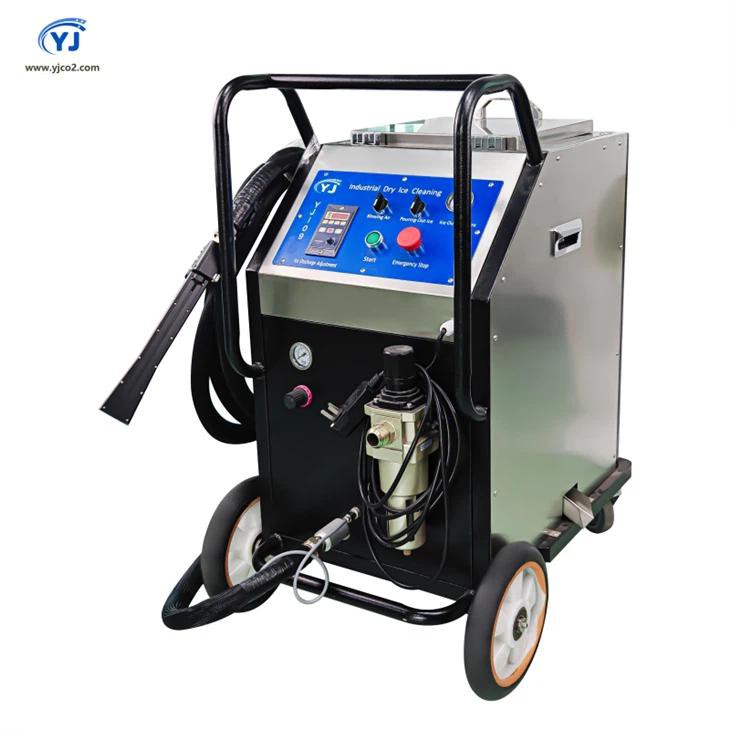
For occasional local cleaning, a portable dry ice blasting machine may be enough. It is easier to move around packaging lines, fixtures, machine frames, and small adhesive buildup points.
For frequent cleaning, large surfaces, heavy residue, or production-line maintenance, an industrial dry ice blasting machine is usually more suitable. It should provide stable pellet feeding, reliable air handling, and enough cleaning output for longer work sessions.
For repeated adhesive buildup in the same position, a customized or automated dry ice cleaning system may be a better long-term answer. This is common in mold cleaning, packaging lines, robotic production cells, and high-volume manufacturing tools.
Before choosing equipment, check these factors:
|
Selection Factor |
Why It Matters |
|
Air pressure |
Controls impact energy on the adhesive layer |
|
Air volume |
Supports continuous pellet delivery |
|
Air dryness |
Reduces blockage and unstable feeding |
|
Pellet size compatibility |
Affects cleaning force and surface sensitivity |
|
Nozzle options |
Determines access, spray width, and impact concentration |
|
Hose length |
Affects flexibility and pellet flow stability |
|
Cleaning frequency |
Decides whether portable, industrial, or automated equipment makes sense |
Dry ice supply should also be considered. If a factory uses dry ice blasting every day, buying pellets from outside may become expensive or unreliable. A dry ice pelletizer can help control pellet freshness, timing, and supply stability.
YJCO2 provides dry ice blasting machines, dry ice pelletizers, and customized dry ice cleaning solutions for industrial adhesive removal. For adhesive residue on molds, packaging machinery, fixtures, rollers, or electronic assembly tools, the right solution depends on the residue, the surface, the air system, and the required cleaning frequency.
FAQ
Can dry ice blasting remove glue residue completely?
It can remove many types of glue residue, especially aged adhesive, label adhesive, tape residue, resin, wax, and release agent buildup. Complete removal depends on adhesive type, thickness, age, surface material, and blasting settings.
Does dry ice blasting dissolve adhesive?
No. Dry ice blasting does not dissolve adhesive like a chemical remover. It cools and embrittles the residue, breaks the adhesive layer with pellet impact, and lifts it away through CO₂ sublimation.
Is dry ice blasting safe for metal equipment?
For most metal equipment, yes. Dry ice blasting is non-abrasive compared with sand or hard blasting media. It can clean stainless steel, mold steel, aluminum, rollers, frames, and fixtures when parameters are set correctly.
Polished, coated, or thin metal parts should still be tested before full cleaning.
Can dry ice blasting be used on plastic or painted surfaces?
Yes, but not blindly. Some plastics and coatings can react to rapid cooling or impact. Use lower pressure, a suitable nozzle, and a small test area first.
Is dry ice blasting better than chemical adhesive remover?
For many industrial equipment cleaning jobs, yes. Dry ice blasting avoids solvent residue, wastewater, strong odor, and chemical handling issues. Chemical removers may still work better for certain uncured adhesives or glue that has penetrated deeply into porous material.
Does dry ice blasting leave residue after cleaning?
The dry ice itself does not leave blasting media because it sublimates into CO₂ gas. The removed adhesive, dust, resin, and dirt still remain in the work area and must be collected.
What type of dry ice blasting machine is best for adhesive removal?
For occasional local cleaning, a portable machine may be enough. For frequent adhesive removal, large equipment, molds, or heavy buildup, an industrial machine with stable air and pellet feeding is usually better. If dry ice consumption is high, a dry ice pelletizer may also be needed.
Dry ice blasting is a strong option for removing adhesive from equipment when the goal is to clean without water, solvents, abrasive media, or unnecessary surface damage. The best result comes from matching the adhesive type, equipment surface, air supply, dry ice quality, and blasting parameters.
If your factory needs to remove adhesive from molds, packaging machinery, production fixtures, rollers, or other industrial equipment, YJCO2 can help evaluate the cleaning process and recommend a suitable dry ice blasting machine or complete dry ice cleaning solution.