


Dry ice cleaning is a service business built around one clear promise: remove contamination without water, chemical washdown, or abrasive blasting media.
That promise matters most when the customer cannot afford long downtime, surface damage, corrosion, chemical residue, or a messy cleanup after cleaning. This is why dry ice cleaning is used in automotive restoration, mold maintenance, food processing, printing, power equipment, electronics, and many industrial maintenance jobs.
But starting a dry ice cleaning business is not just buying a dry ice blasting machine.
You need the right target market, the right air supply, a reliable dry ice plan, trained operators, safety controls, and a way to show customers the value before they understand the technology.
This guide explains what to check before you invest.
Is a Dry Ice Cleaning Business a Good Opportunity?
A dry ice cleaning business can be a good opportunity when you target customers who already lose money from dirty equipment, long shutdowns, manual scraping, chemical cleaning, or water-based cleaning.
The best customers are usually not looking for "cleaning" in a general sense. They are trying to solve one of these problems:
- A mold is dirty, but removing and cooling it takes too long.
- A food production line needs cleaning, but water and chemical residues create extra risk.
- A classic car underside needs restoration without sanding away original details.
- A printing machine has ink buildup in areas that are hard to reach.
- Electrical or mechanical equipment needs dry cleaning instead of pressure washing.
- A factory wants less downtime during maintenance.
That is the real business case.
Dry ice cleaning, also called dry ice blasting or CO₂ blasting, uses dry ice pellets and compressed air to remove contamination from a surface. The dry ice sublimates after impact, meaning it changes from solid CO₂ directly into gas. It does not leave sand, water, soda, or blasting grit behind.
This makes it attractive in industries where downtime, surface finish, and cleanup cost matter.
Still, this is not a low-effort side business. A machine alone will not create revenue. You need compressed air, dry ice supply, transport, safety training, spare parts, proof of results, and customers who understand why this method is worth paying for.
Start with the market, not the machine.
If your target customer is classic car restoration, you may need a compact mobile setup and gentle nozzles. If your target customer is tire mold cleaning, you need higher productivity, stable air flow, and a clear plan for dry ice consumption. If your target customer is food processing, safety procedures and residue-free cleaning become part of your sales argument.
Your customer decides your setup.
What Is Dry Ice Cleaning and Why Do Customers Pay for It?
Dry ice cleaning is a dry industrial cleaning process that propels solid CO₂ pellets onto a contaminated surface using compressed air. The process removes dirt, oil, grease, carbon, resin, adhesive, release agent, ink, paint residue, food deposits, and other contaminants without adding water or chemical cleaning agents.
Customers pay for it because it can reduce shutdown time and cleanup work.
A mold can often be cleaned in place.
A production line may need less disassembly.
A cleaned surface may not need drying.
The removed waste is mainly the contamination itself.
That is where the value comes from.
The Three Physical Effects Behind Dry Ice Blasting
Dry ice blasting works through three physical effects.
|
Effect |
What Happens |
Why It Matters |
|
Mechanical impact |
Dry ice pellets strike the contamination at high speed |
Helps break or loosen the surface layer |
|
Thermal shock |
The low temperature of dry ice, around -78.5°C, makes many deposits shrink and become brittle |
Helps separate oil, resin, rubber residue, coating, or release agent from the base surface |
|
Sublimation expansion |
Dry ice turns into CO₂ gas after impact and expands rapidly |
Helps lift loosened contamination away from the surface |
This is why dry ice cleaning can remove stubborn material without acting like sandblasting.
The impact does work, but the freezing and sublimation effects do much of the separation. That is also why nozzle choice, pellet quality, air pressure, and distance from the surface all change the result.
For example, cleaning carbon deposits from a metal part may require stronger air flow and a narrow nozzle. Cleaning a delicate mold surface may require lower pressure, a wider pattern, and careful testing before full operation.
The method is simple to explain, but the result depends on setup.
Why It Is Different from Water, Chemical, or Abrasive Cleaning
Dry ice cleaning is often compared with high-pressure water, chemical cleaning, sanding, soda blasting, and abrasive blasting. Each method has a place. Dry ice cleaning is strongest where water, chemicals, or abrasive media create secondary problems.
|
Cleaning Method |
Main Strength |
Main Limitation |
|
High-pressure water |
Fast for many outdoor and washable surfaces |
Creates wastewater, drying time, corrosion risk, and electrical limitations |
|
Chemical cleaning |
Good for certain oils, coatings, and residues |
Requires chemical handling, dwell time, disposal, and worker protection |
|
Sand or abrasive blasting |
Strong removal power |
Can change surface profile, create dust, and damage precision surfaces |
|
Soda blasting |
Less aggressive than sand |
Leaves media residue and still needs cleanup |
|
Dry ice cleaning |
Dry, non-abrasive, no secondary blasting media |
Requires compressed air, dry ice supply, and trained operators |
Dry ice cleaning does not mean "no cleanup at all." The removed dirt still has to be collected.
But it avoids a second waste stream from water, sand, soda, or chemical washdown. That difference is often enough to make the process worth using.
What Services and Markets Can You Target?
A dry ice cleaning business should not try to sell to everyone at the beginning. The service is flexible, but your marketing, equipment, pricing, and training will be stronger if you start with a defined market.
The best early market is usually one where the customer has a painful cleaning problem and can see the result quickly.
Automotive and Restoration Cleaning
Automotive dry ice cleaning has grown because the results are easy to show. Before-and-after photos work well. Videos work even better.
Common services include:
- Engine bay cleaning
- Undercarriage cleaning
- Suspension and wheel well cleaning
- Classic car restoration
- High-end detailing
- Grease and road grime removal
- Fire restoration
- Graffiti removal on certain surfaces
For automotive work, the cleaning goal is not always maximum aggression. Many customers want preservation. They want dirt removed without sanding, soaking, or damaging original coatings, labels, rubber, wiring, or finishes.
A mobile dry ice blasting setup is common in this market. The vehicle, compressor, dry ice storage, hose length, and noise control matter almost as much as the cleaning machine.
Automotive work is also a good entry point because the sales process is visual. A customer can see the value in one cleaned section.
Mold, Tooling, and Industrial Equipment Cleaning
Mold cleaning is one of the strongest industrial use cases for dry ice blasting.
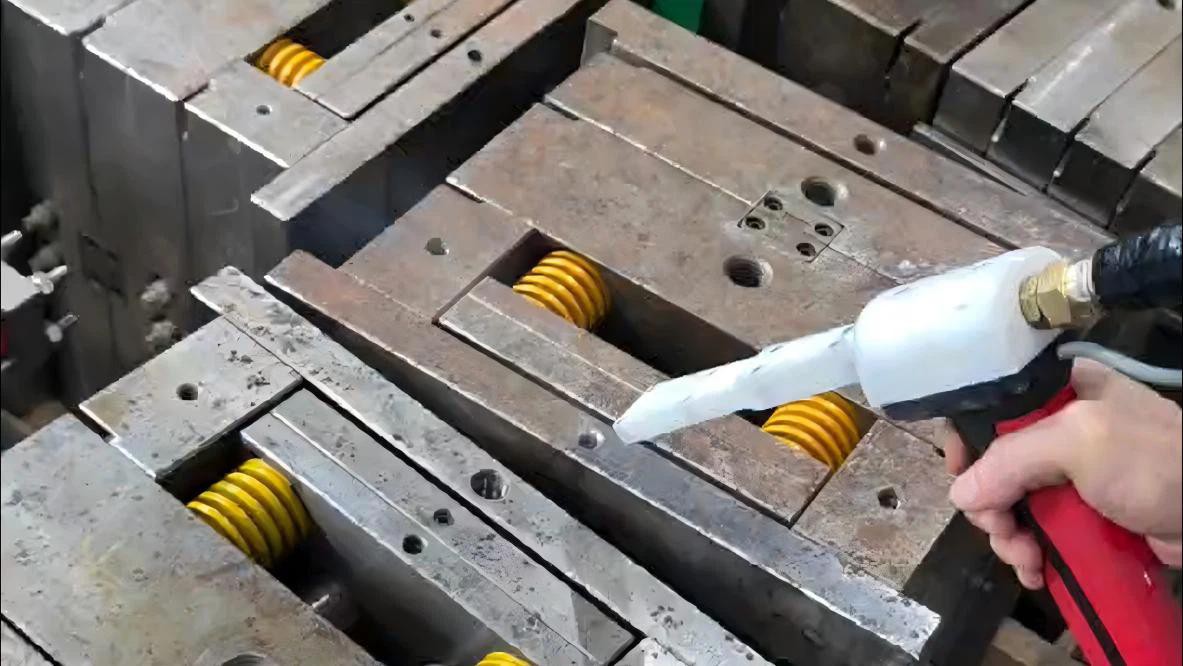
Injection molds, tire molds, rubber molds, die-casting tools, and forming tools collect release agents, rubber residue, resins, oils, carbon, and other deposits. Traditional cleaning often means removing the mold, cooling it, scraping it, using chemicals, or sending it to a separate cleaning area.
That takes time.
Dry ice cleaning can often be done with less disassembly. For tire molds and rubber molds, this is a major advantage because fine grooves and patterns are hard to clean by hand. For injection molds, non-abrasive cleaning helps protect surface finish and tolerances.
Industrial dry ice cleaning services can also target:
- Production line equipment
- Motors and generators
- Transformers and electrical components, when procedures allow
- Heat exchangers
- Printing machines
- Conveyors
- Boilers and furnace-related components
- Petrochemical equipment
- Reactors and tanks
- Packaging machinery
Industrial customers usually pay for reduced downtime, not just a clean surface.
If a factory loses production while equipment is offline, a faster cleaning process has a business value that is much higher than the labor cost alone.
Food, Packaging, Electronics, and Precision Cleaning
Food and packaging companies often need cleaning methods that reduce water use and chemical residue. Dry ice cleaning can be useful for bakery equipment, conveyors, mixers, packaging machines, ovens, and production surfaces where water-based cleaning creates drying time or contamination concerns.
Electronics and precision equipment require a different approach. The selling point is not force. It is controlled cleaning. Dry ice is dry and non-conductive under proper conditions, but that does not remove the need for safety review, static control, ventilation, and process testing.
For precision cleaning, test first. Always.
This is where many beginners make mistakes. They see dry ice cleaning remove heavy grease from steel and assume the same setup can be used on every surface. It cannot. Pressure, nozzle, pellet size, air volume, and distance all need adjustment.
The more valuable the customer's equipment, the more careful your process must be.

What Equipment and Supply Setup Do You Need to Start?
A dry ice cleaning setup is a system. The blasting machine is only one part of it.
A weak compressor can make a good machine perform badly. Poor pellet quality can cause inconsistent cleaning. Wrong nozzles can waste dry ice. Bad storage can turn purchased dry ice into gas before it earns any money.
Dry Ice Cleaning Machine, Compressor, and Accessories
A basic dry ice cleaning business normally needs the following equipment.
|
Equipment |
Function |
What to Check |
|
Dry ice cleaning machine |
Feeds and meters dry ice into the air stream |
Pellet compatibility, feed control, reliability, hose length, ease of maintenance |
|
Air compressor |
Provides the energy for blasting |
Pressure, air flow, moisture control, fuel or power source |
|
Aftercooler / air dryer |
Reduces moisture in compressed air |
Helps avoid clogging, freezing, and unstable blasting |
|
Nozzles |
Shape cleaning force and spray pattern |
Narrow, wide, angled, extension, low-aggression options |
|
Blast hose and gun |
Delivers air and dry ice to the surface |
Hose length, flexibility, wear parts |
|
Dry ice storage container |
Slows sublimation loss |
Insulation quality, job duration, transport needs |
|
PPE |
Protects operators |
Gloves, eye protection, hearing protection, protective clothing |
|
CO₂ monitoring / ventilation plan |
Controls gas exposure risk |
Indoor work, confined spaces, basement areas, food plants |
|
Vehicle or trailer |
Supports mobile service |
Space for machine, compressor, dry ice, tools, fuel, safety gear |
Many small and medium dry ice cleaning machines work with compressed air in the range of about 6–10 bar. Air flow requirements vary widely. Some lighter applications may run with lower flow, while industrial jobs can need much higher volume. For larger mobile setups, compressors in the 250–600 CFM range are common.
Do not buy the machine and then guess the compressor.
Match the machine, compressor, nozzle, and job type before spending money.
Mobile Setup vs. Fixed Workshop Setup
Most new service businesses consider mobile work first. The reason is simple: many customers want the cleaning done where the equipment sits.
A mold shop may not want to remove a tool.
A factory may not want to move a conveyor.
A car owner may prefer on-site work.
A restoration contractor may need the service at a job site.
But mobile work adds its own requirements.
|
Setup Type |
Best For |
Advantages |
Limits |
|
Mobile dry ice blasting business |
Automotive, factories, restoration, commercial sites |
Goes to the customer, reduces customer downtime, wider service area |
Requires vehicle, portable compressor, dry ice transport, more logistics |
|
Fixed workshop setup |
Batch parts, car detailing shop, repeat components, controlled cleaning |
Stable air supply, better workflow, easier storage and safety control |
Customer must bring parts or vehicles to you |
|
Hybrid setup |
Growing service providers |
Can handle both on-site and in-house jobs |
Higher equipment and space planning needs |
A fixed workshop can be more efficient if you have repeat work. A mobile setup can win more first customers because it solves the customer's downtime problem.
Choose based on where the dirty equipment is.
Buying Dry Ice Pellets vs. Using a Dry Ice Pelletizer
Dry ice supply is one of the biggest operational questions in this business.
Most beginners buy dry ice pellets from a local supplier. That is the easiest way to start. You avoid the higher investment of making dry ice yourself, and you can test your market before building a bigger setup.
But dry ice sublimates. It starts disappearing as soon as it is made.
If your supplier is far away, delivery is unreliable, or your jobs use large amounts of dry ice, your real cost may be higher than the invoice price. Lost dry ice, delayed jobs, and short storage life all matter.
|
Dry Ice Supply Option |
Best For |
Main Benefit |
Main Risk |
|
Buying dry ice pellets |
Beginners, low-volume jobs, testing a market |
Lower initial investment, simple operation |
Supply delays, sublimation loss, price changes |
|
Using a dry ice pelletizer |
High-volume users, industrial service providers, remote markets |
Better control of supply, fresh pellets, possible lower long-term cost |
Higher initial investment, needs liquid CO₂ supply and space |
|
Mixed approach |
Growing businesses |
Flexibility during demand changes |
Requires planning and inventory control |
A dry ice pelletizer is a machine that makes dry ice pellets from liquid CO₂. It is not required for every startup. It becomes more attractive when your dry ice consumption is high, your supply is unstable, or you want to support several cleaning machines.
In some regions, the challenge is not just the blasting machine. The customer may also struggle to source dry ice, air compressors, hoses, nozzles, or storage systems. That type of startup problem can be solved through a complete equipment-and-supply package. YJCO2 provides dry ice, cleaning equipment, and supporting system options for customers who need a more complete setup instead of separate purchases from multiple suppliers.
The right supply setup reduces missed jobs. That matters more than a small saving on one machine.
How Much Does It Cost to Start a Dry Ice Cleaning Business?
The cost to start a dry ice cleaning business depends on your market, equipment level, compressor choice, vehicle needs, and dry ice plan.
A small automotive setup does not cost the same as an industrial mobile service setup. A company making its own dry ice pellets needs a different budget from a beginner buying pellets locally.
Use the following ranges as planning categories, not fixed quotes.
Basic Startup Setup
A basic setup is for testing the market or serving lighter jobs such as automotive cleaning, small restoration work, or occasional commercial cleaning.
Typical items include:
- Portable dry ice cleaning machine
- Smaller compressor or rented compressor
- Basic nozzle set
- Blast hose and gun
- Dry ice storage box
- PPE
- Simple website
- Local advertising
- Basic insurance
In North America and Europe, a basic entry setup can often fall into a lower five-figure investment once the machine, air source, accessories, and basic business costs are included. The range can change sharply if you already own a compressor or vehicle.
This setup is useful when you need proof of local demand before buying heavier equipment.
Standard Mobile Business Setup
A standard mobile business setup is for serious on-site service work.
This is the level many dry ice blasting service providers aim for when they want to serve factories, automotive shops, restoration contractors, food plants, or mold customers.
Typical items include:
- More capable dry ice blasting machine
- High-flow compressor
- Air dryer or aftercooler
- Vehicle or trailer
- Better dry ice storage
- Multiple nozzles
- Extension tools
- CO₂ monitoring equipment for indoor work
- Insurance
- Operator training
- Fuel and transport budget
- Website, local SEO, video content, and sales outreach
This type of setup can move into a much higher investment range because the compressor and vehicle may cost as much as, or more than, the cleaning machine.
Many new operators underestimate the compressor cost. Do not make that mistake.
A good dry ice blasting machine needs stable air. If the air supply is weak, wet, or undersized, the cleaning effect becomes inconsistent and dry ice consumption rises.
High-Volume or In-House Dry Ice Setup
A high-volume setup is for industrial service providers, large plants, or businesses that plan to run multiple jobs per week with predictable dry ice demand.
This may include:
- Industrial dry ice cleaning machine
- Larger compressor system
- Dry ice pelletizer
- Liquid CO₂ supply
- Dry ice storage and handling area
- Spare parts inventory
- More trained operators
- Formal safety procedures
- Maintenance program
- Dedicated transport or workshop space
This setup costs more, but it can solve supply problems and support larger customers.
The decision should be based on dry ice consumption, job frequency, customer value, and local supply conditions. If you only clean a few cars per month, making your own pellets probably makes no sense. If you serve factories every week and dry ice delivery is unreliable, it may become a serious option.
Cost planning should start with the jobs you expect to sell, not the biggest machine you can afford.
How Do You Get Customers and Price Your Services?
A dry ice cleaning business needs education-based selling. Many customers have heard of pressure washing, chemical cleaning, sandblasting, or manual scraping. They may not understand why dry ice blasting costs more.
Show them.
Use Visual Proof to Sell the Service
Dry ice cleaning is visual. Your marketing should be visual too.
Before-and-after photos, short videos, and live demonstrations often sell better than long explanations. This is especially true for automotive detailing, mold cleaning, graffiti removal, and industrial maintenance.
Useful marketing assets include:
- One-minute cleaning videos
- Side-by-side before-and-after photos
- A cleaned test section on customer equipment
- Short case pages by industry
- Customer testimonials
- Photos of your equipment setup
- Clear explanation of what contamination was removed
A mold customer wants to see whether fine grooves are clean.
A car owner wants to see the underside before and after.
A food plant wants to know if cleaning can reduce water use and downtime.
Do not make customers imagine the result. Show it.
Local SEO, B2B Outreach, and Partnerships
For local service businesses, search visibility matters. Many customers search for phrases such as dry ice cleaning near me, dry ice blasting service near me, or automotive dry ice cleaning.
A basic local marketing plan should include:
- Google Business Profile
- Service pages for each target industry
- Before-and-after galleries
- Location pages if you serve multiple cities
- Short video content
- LinkedIn outreach to plant managers and maintenance teams
- Direct visits to industrial parks
- Partnerships with automotive restoration shops
- Partnerships with equipment maintenance companies
- Relationships with food processing, packaging, and mold shops
B2B customers often take longer to close. They may need a demo, safety documents, insurance proof, and internal approval. That is normal.
For first customers, offer a paid test clean or a controlled demo on a small section. Free work can attract the wrong people. A small paid trial filters for serious buyers.
Pricing Models and Maintenance Contracts
Dry ice cleaning pricing can be based on time, project scope, equipment type, contamination level, or a maintenance contract.
|
Pricing Model |
Best For |
Notes |
|
Hourly rate |
Unknown contamination, first-time jobs, troubleshooting work |
Easier for uncertain jobs, but customer may worry about open-ended cost |
|
Project pricing |
Mold cleaning, vehicle cleaning, production equipment |
Better when scope can be inspected and estimated |
|
Area-based pricing |
Floors, walls, graffiti, restoration surfaces |
Works when surface area is measurable |
|
Equipment-based pricing |
Specific machines, molds, conveyors, ovens |
Easy for repeat customers |
|
Maintenance contract |
Food plants, mold shops, factories |
Creates repeat revenue and better schedule planning |
The best dry ice cleaning businesses usually move toward repeat work.
One-time jobs are useful. Maintenance contracts are better. A food plant that needs monthly conveyor cleaning or a mold shop that needs regular tool cleaning can give steadier revenue than random one-off jobs.
Do not price only by labor time. Include dry ice, travel, compressor fuel, setup time, wear parts, operator skill, safety requirements, and cleanup.
A difficult industrial job should not be priced like a driveway cleaning service.
How Profitable Is a Dry Ice Cleaning Business?
A dry ice cleaning business can be profitable, but profit depends on use rate and cost control.
The hourly rate is only one part of the picture. A machine that sits unused for most of the week does not care what rate you list on your website. Dry ice lost to sublimation still costs money. Travel time can eat margin. Poor compressor matching can make a job slower and more expensive.
Key Profit Drivers
The main profit drivers are:
- Billable hours per week
- Quality of target customers
- Dry ice consumption per job
- Dry ice sublimation loss
- Compressor fuel or electricity cost
- Operator labor cost
- Travel distance
- Setup and cleanup time
- Equipment maintenance
- Nozzle and hose wear
- Pricing discipline
- Repeat contracts
Dry ice consumption can vary widely. Some jobs may use around 0.5 kg per minute. Heavy industrial jobs can use more than 2 kg per minute depending on machine, nozzle, pressure, and contamination. If dry ice is expensive in your region, consumption control becomes a major profit factor.
The most profitable jobs are not always the fastest jobs. They are the jobs where the customer has a real cost of downtime or damage.
A tire mold cleaning job that reduces downtime may be worth more than a simple surface cleaning task. A food equipment job that avoids chemical residue may carry more value than general facility cleaning. An industrial customer with repeat needs is usually more valuable than a one-time low-price customer.
Common Risks New Businesses Should Plan For
New dry ice cleaning businesses often run into the same problems.
They buy a blasting machine without checking air supply.
They assume dry ice will be easy to get every week.
They underestimate transport and setup time.
They market to low-value customers.
They do not document results.
They fail to explain why dry ice cleaning costs more than pressure washing.
Common risks include:
- Unstable dry ice supply
- High sublimation loss
- Undersized compressor
- Wrong machine for the target market
- Weak safety training
- Indoor CO₂ exposure risk
- Noise complaints
- Customer education burden
- Low-price competitors
- Seasonal demand changes
- Spare parts delays
- Poor local search visibility
The safest way to start is to choose one or two strong markets, test cleaning results, document the process, and build pricing around real job costs.
A dry ice cleaning business fails when it treats every job the same. It works better when each service is matched to the surface, contamination, customer downtime, and safety conditions.
How to Choose the Right Supplier and Start Safely
Choosing a supplier is not only about machine price. For a service business, the supplier affects machine selection, dry ice consumption, operator training, spare parts, and job capability.
A cheaper machine can become expensive if it requires too much air, wastes dry ice, breaks often, or cannot be supported quickly.
Safety, Training, and Compliance Checklist
Dry ice cleaning uses compressed air, high noise levels, low-temperature dry ice, and CO₂ gas. Operators need training before working on customer sites.
Check these areas before taking paid jobs:
- CO₂ ventilation for indoor work
- Confined space risk
- CO₂ monitoring when needed
- Frostbite protection
- Eye protection
- Hearing protection
- Protective gloves and clothing
- Safe dry ice storage
- Safe dry ice transport
- Compressed air hose safety
- Machine startup and shutdown procedures
- Emergency response plan
- Insurance
- Local business licensing
- Customer site safety rules
Rules vary by country, state, and city. In the United States, operators may need to consider OSHA workplace safety expectations, DOT dry ice transportation rules, local business licensing, insurance, and customer-specific requirements. Food, pharmaceutical, and aerospace customers may have their own documentation needs.
Do not treat safety paperwork as an afterthought. Industrial customers often judge a cleaning contractor by how prepared they are before the job starts.
What to Look for in a Dry Ice Cleaning Equipment Supplier
A good dry ice cleaning equipment supplier should help you match the setup to the work you plan to sell.
Look for these capabilities:
Dry ice cleaning machine options for different job sizes
Portable and industrial machine choices
- Dry ice pelletizer options if your supply needs justify it
- Compressor and air supply guidance
- Nozzle recommendations for different applications
- Training support
- Spare parts availability
- Troubleshooting support
- Application testing
- Export configuration if equipment is shipped internationally
- Ability to support custom setups when standard equipment does not fit
For a startup, this support can matter more than one specification on a brochure.
If you plan to clean molds, ask about mold applications. If you plan to work in food plants, ask about dry, residue-free cleaning procedures. If you plan to serve automotive customers, ask about lower-aggression setups and mobile workflow. If you are in a region without reliable dry ice supply, discuss pellet supply or in-house pellet production before you buy the blasting machine.
The best supplier helps you avoid a mismatched system.
FAQ: Common Questions Before You Start
Is dry ice cleaning profitable?
It can be, especially when you serve customers with high downtime costs or repeat cleaning needs. Profit depends on equipment use rate, dry ice cost, travel time, pricing, and customer quality.
How much does it cost to start a dry ice blasting business?
A small setup may require a lower five-figure investment, while a mobile industrial setup or in-house dry ice production system can cost much more. The machine is only one part of the budget. Compressor, vehicle, accessories, dry ice storage, insurance, safety gear, and marketing also count.
What equipment do I need for dry ice cleaning?
At minimum, you need a dry ice cleaning machine, compressed air source, dry ice pellets, blast hose, gun, nozzles, dry ice storage, and PPE. Mobile businesses also need transport and a plan for on-site air and dry ice handling.
Do I need a dry ice pelletizer?
Not at the beginning in many cases. Buy pellets first if local supply is reliable and your job volume is low. Consider a dry ice pelletizer when dry ice use becomes high, supply is unstable, or you need fresher pellets for frequent industrial work.
Should I start mobile or fixed-location?
Start mobile if your customers need on-site cleaning or cannot move equipment. Start fixed-location if you have repeat parts, vehicles, or components coming to your workshop.
What industries need dry ice cleaning?
Common markets include automotive restoration, mold cleaning, tire manufacturing, food processing, packaging, printing, electronics, power equipment, petrochemical maintenance, and industrial machinery cleaning.
Is dry ice blasting safe?
It can be safe when operators are trained and the site is controlled. Main risks include CO₂ buildup, frostbite, compressed air hazards, flying debris, and noise. Indoor and confined work needs special care.
Can dry ice cleaning damage surfaces?
Yes, if the setup is wrong. Dry ice is non-abrasive compared with sand or grit, but air pressure, nozzle choice, distance, and operator technique still matter. Test sensitive surfaces first.
What size compressor do I need for dry ice blasting?
It depends on the machine and application. Many systems need around 6–10 bar pressure, while air flow requirements vary from lighter setups to high-volume industrial compressors. Always match the compressor to the machine and nozzle, not just the pressure rating.
How do I find my first dry ice cleaning customers?
Start with visible results. Use before-and-after photos, short videos, paid demos, local SEO, Google Business Profile, and direct outreach to automotive shops, mold shops, food plants, maintenance teams, and restoration contractors.
Final Thoughts
Starting a dry ice cleaning business is mainly a question of fit.
Fit the service to a market.
Fit the machine to the job.
Fit the compressor to the machine.
Fit the dry ice supply to your workload.
Fit your pricing to the customer's real downtime and cleaning problem.
If those pieces line up, dry ice cleaning can become a strong B2B service business. If they do not, even a good machine will sit unused.
If dry ice supply, compressed air, or equipment matching is a barrier in your local market, YJCO2 can help you review the full setup and choose a practical dry ice cleaning solution for your target applications. Contact us to discuss your market, cleaning jobs, and equipment plan.
