


Dry ice is made of solid carbon dioxide, not frozen water.
That one fact explains almost everything about it: why it feels extremely cold, why it disappears instead of melting, why it leaves no puddle, and why it can be used for cooling, shipping, special effects, and industrial dry ice cleaning.
At normal atmospheric pressure, dry ice changes directly from a solid into carbon dioxide gas. This process is called sublimation. During sublimation, dry ice absorbs heat from its surroundings and leaves no liquid water behind.
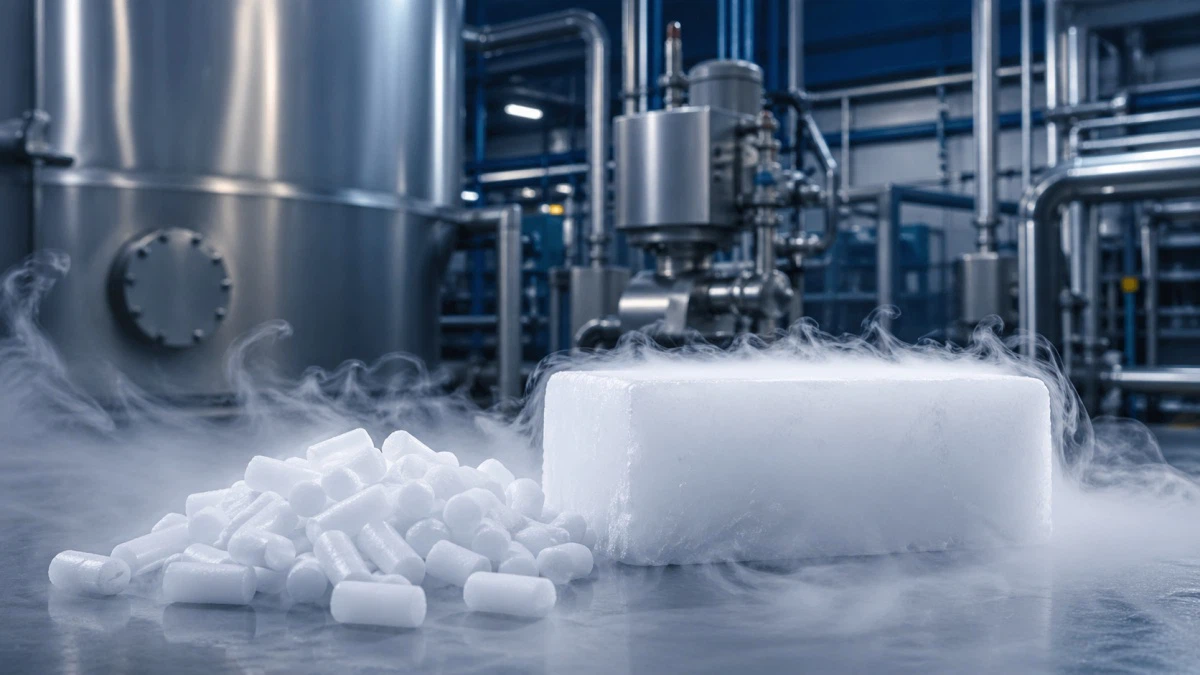
1. What Is Dry Ice Made of and How Does It Work?
Dry ice is the solid form of carbon dioxide , usually written as CO₂. Carbon dioxide is a colorless and odorless gas under normal conditions, but under controlled pressure and temperature, it can be converted into a solid.
Dry ice works through three basic physical effects:
It is very cold, about -78.5°C / -109.3°F at atmospheric pressure.
It sublimates directly from solid to gas.
It absorbs heat as it sublimates.
Regular ice cools something by melting into water. Dry ice cools something by turning into gas. That difference matters in real applications.
If you are shipping seafood, medicine, or frozen products, dry ice can keep the load cold without adding meltwater. If you are cleaning a mold, motor, conveyor, or production tool, dry ice can remove contamination without soaking the equipment.
Dry ice is simple in composition, but its behavior is different enough from water ice that it needs to be understood before it is used.
2. What Is the Composition of Dry Ice?
Dry ice is composed of solid carbon dioxide.
It is not made of water. It does not contain H₂O as its main ingredient. It is not the same material as the ice you take from a freezer.
When people ask "what is dry ice made of," the direct answer is:
Dry ice is made of CO₂ in solid form.
In industrial supply chains, the CO₂ used for dry ice production is often recovered from existing industrial processes, purified, liquefied, and then converted into dry ice. This makes dry ice different from many disposable cooling materials, but it should not be described as zero-emission. When dry ice sublimates, it becomes CO₂ gas again.
The practical value is not that dry ice is magic. The value is that it can cool, clean, or create effects without leaving liquid water behind.
|
Material |
Main Composition |
What Happens as It Warms |
Leaves Water? |
|
Regular ice |
Water, H₂O |
Melts into liquid water |
Yes |
|
Dry ice |
Carbon dioxide, CO₂ |
Sublimates into CO₂ gas |
No |
|
Liquid nitrogen |
Nitrogen, N₂ |
Boils into nitrogen gas |
No, but requires very low-temperature handling |
For most industrial users, the key difference is not the chemistry formula. It is the behavior after use.
Dry ice disappears as gas. That is why it is called "dry."
3. How Is Dry Ice Produced?
Industrial dry ice production starts with liquid carbon dioxide.
The process is usually built around pressure control. CO₂ gas is compressed and cooled until it becomes liquid CO₂. Then that liquid CO₂ is released through a controlled pressure drop. Part of the CO₂ flashes back into gas, and that expansion absorbs heat. The remaining CO₂ freezes into a snow-like solid called dry ice snow.
That dry ice snow is then compressed into usable forms.
A typical dry ice production process looks like this:
1.CO₂ gas is compressed and cooled
The gas is converted into liquid CO₂ under pressure.
2.Liquid CO₂ is depressurized
The liquid passes through a controlled release system.
3.Dry ice snow forms
Rapid expansion cools part of the CO₂ into solid snow.
4.The snow is compressed
Mechanical pressure forms pellets, blocks, slices, or nuggets.
5.The dry ice is packed or sent directly to use
For cleaning, pellets are usually preferred because they can be fed into a dry ice blasting machine.
The production step matters because dry ice is not one universal shape. The form determines how it performs.
Common Forms of Dry Ice
|
Dry Ice Form |
Typical Size / Shape |
Main Use |
Practical Note |
|
Dry ice pellets |
Small cylindrical pellets |
Dry ice cleaning, food processing, cold chain |
Easy to feed into blasting machines |
|
Dry ice blocks / slabs |
Large blocks |
Long-distance cooling, frozen transport |
Sublimate more slowly than small pieces |
|
Dry ice slices |
Flat cut sections |
Food, medical, laboratory cooling |
Easier to stack and pack |
|
Dry ice nuggets |
Irregular or compact pieces |
Commercial cooling, short-term cooling |
Flexible but less precise for blasting |
For dry ice cleaning, pellet quality matters. Poorly formed pellets break down quickly, create inconsistent feed, and reduce cleaning stability. In a factory environment, that can mean uneven cleaning results and more downtime.
Dry ice is not only a material. In industrial use, it is part of a system.
4. How Does Dry Ice Work?
Dry ice works because of extreme cold, sublimation, heat absorption, and gas expansion.
Those are physical effects. There is no chemical reaction required for most dry ice applications.
Extreme Cold Provides Fast Cooling
At atmospheric pressure, dry ice is about -78.5°C / -109.3°F. That is far colder than regular ice, which melts around 0°C / 32°F.
This makes dry ice suitable for low-temperature transport and fast cooling.
For example, frozen seafood, meat, ice cream, biological samples, and certain pharmaceuticals may need cold conditions during transport. Regular ice can help, but it melts. Water then becomes a problem for packaging, hygiene, labeling, and product stability.
Dry ice avoids that problem.
The cold is also useful in cleaning. When dry ice pellets hit oil, resin, rubber residue, or adhesive buildup, the sudden low temperature can make the contamination contract and become brittle. That makes it easier to detach from the surface.
Sublimation Absorbs Heat
Sublimation means a solid changes directly into gas without becoming liquid.
When dry ice sublimates, it absorbs heat from nearby air, products, or surfaces. That heat absorption is why dry ice keeps cooling as it disappears.
This is the same reason dry ice produces fog when placed in warm water. The cold CO₂ gas cools moisture in the air, and that moisture condenses into tiny visible droplets. The white fog is not carbon dioxide itself. It is condensed water vapor carried by the cold gas flow.
Dry Ice Leaves No Liquid Residue
Because dry ice does not melt into water, it leaves no liquid residue.
That is useful in:
- Frozen food shipping
- Medical sample transport
- Laboratory cooling
- Electrical equipment cleaning
- Mold cleaning
- Food processing equipment maintenance
In dry ice blasting, this is one of the biggest advantages. The dry ice pellets disappear after impact, leaving only the removed dirt, oil, carbon, resin, or coating residue to collect.
Gas Expansion Helps Remove Contamination
When dry ice pellets hit a warm surface, they sublimate quickly. Solid CO₂ becomes gas, and the gas expands.
In industrial cleaning, this expansion helps lift contamination away from the base material. It is not the only cleaning force, but it is one of the reasons dry ice blasting can clean without leaving sand, water, or chemical residue.
Dry ice works best when its physical behavior is matched to the job. Cooling, shipping, and blasting all depend on the same material, but they need different forms and equipment.
5. Why Doesn't Dry Ice Melt Like Regular Ice?
Dry ice does not melt like regular ice because it is not water.
Regular ice is solid H₂O. As it warms, it changes from solid ice into liquid water. If heat continues, that water evaporates into vapor.
Dry ice is solid CO₂. At normal atmospheric pressure, carbon dioxide does not pass through a liquid stage. It changes directly from solid to gas.
That is sublimation.
|
Comparison |
Regular Ice |
Dry Ice |
|
Composition |
Water, H₂O |
Carbon dioxide, CO₂ |
|
Temperature point |
Melts around 0°C / 32°F |
Sublimates around -78.5°C / -109.3°F |
|
State change |
Solid → liquid → gas |
Solid → gas |
|
Liquid residue |
Yes |
No |
|
Common use |
Drinks, basic cooling |
Deep cooling, shipping, dry ice cleaning, fog effects |
|
Main risk |
Water leakage, slipping |
Frostbite, CO₂ buildup in enclosed areas |
This is also why dry ice must not be stored in an airtight container. As it sublimates, CO₂ gas builds pressure. A sealed container can rupture.
The same property that makes dry ice useful also makes safe handling necessary.
6. What Is Dry Ice Used For?
Dry ice is used wherever low temperature and no liquid residue are useful.
The most common applications are cold chain transport, food storage, medical logistics, special effects, and industrial cleaning.

Cold Chain Transport and Food Preservation
Dry ice is widely used for frozen food, seafood, meat, ice cream, and other temperature-sensitive goods.
The reason is straightforward: it is much colder than regular ice and does not create meltwater. In long-distance shipping, that helps protect packaging and product quality.
A large dry ice block usually lasts longer than small pellets because it has less surface area exposed to air. Pellets sublimate faster, but they are easier to distribute around products.
For transport, the choice between pellets, slices, and blocks is not random. It depends on shipping time, insulation, product sensitivity, and how the package is loaded.
Medical, Laboratory, and Biological Sample Transport
Dry ice is also common in medical and laboratory logistics. Biological samples, tissues, certain diagnostic materials, and temperature-sensitive research samples may need stable low-temperature conditions during transport.
In these settings, packaging and ventilation design matter. Dry ice releases CO₂ gas, so shipping containers must allow pressure relief while still keeping the load cold.
The material is useful, but the packing method decides whether it works safely.
Stage Fog and Special Effects
Dry ice can create low-lying white fog when placed in warm water.
The fog forms because cold CO₂ gas cools the moisture in surrounding air. That water vapor condenses into tiny droplets, creating a dense fog effect that stays close to the ground for a short time.
This application is simple, but it still requires ventilation. CO₂ gas can collect in low areas, especially in poorly ventilated indoor spaces.
Industrial Cleaning and Equipment Maintenance
Dry ice cleaning, also called dry ice blasting, uses dry ice pellets as a cleaning medium. The pellets are accelerated by compressed air and directed at contaminated surfaces.
It is often used to remove:
- Oil and grease
- Carbon buildup
- Adhesive residue
- Resin
- Rubber residue
- Release agents
- Ink
- Food residue
- Dust and production buildup
Common industrial targets include molds, conveyor systems, motors, electrical cabinets, food processing equipment, printing rollers, and automotive parts.
Dry ice cleaning is not just "cleaning with something cold." It is a controlled blasting process.
Emergency Cooling and Other Uses
Dry ice can also be used for emergency cooling, such as protecting food or medicine during power outages. It may also appear in specialized technical uses, but for most commercial and industrial users, cooling and cleaning are the main areas of value.
The broad use of dry ice comes from one core behavior: it cools deeply and leaves no liquid water behind.
7. Dry Ice in Industrial Cleaning: Applications and Working Principle
Dry ice cleaning is an industrial cleaning method that uses compressed air to blast dry ice pellets onto a contaminated surface.
The dry ice pellets do not act like sand or metal shot. They are soft compared with abrasive media, extremely cold, and they disappear after impact.
That makes the process useful when water, chemicals, or abrasive residue would create extra work or risk.
Where Dry Ice Cleaning Is Used
|
Industry / Area |
Typical Cleaning Target |
Common Contamination |
|
Rubber and tire molding |
Tire molds, rubber molds |
Rubber residue, release agents, carbon buildup |
|
Plastic injection molding |
Injection molds, tooling |
Resin, additives, release agents |
|
Automotive manufacturing |
Engine parts, welding fixtures, production tools |
Oil, grease, carbon, adhesive |
|
Food processing |
Conveyors, baking trays, mixers, filling equipment |
Grease, sugar, starch, food residue |
|
Electrical and power equipment |
Motors, cabinets, generators |
Dust, oil film, carbon dust |
|
Printing and packaging |
Printing rollers, glue rollers, packaging machines |
Ink, glue, paper dust |
|
General machinery |
Machine frames, production lines, surfaces |
Oil sludge, dirt, old buildup |
A tire mold is a good example. Traditional cleaning may require cooling the mold, removing it from production, using chemicals or hand tools, and then drying or reinstalling it. Dry ice blasting can often clean the mold surface with less disassembly, depending on access and contamination level.
That is why downtime becomes part of the cleaning decision.
The Three Working Principles of Dry Ice Cleaning
Dry ice blasting removes contamination through three combined effects.
1. Thermal Shock
When dry ice pellets hit contamination, the surface temperature drops sharply. Oil films, resin, rubber residue, or release agents can contract and become brittle.
This weakens the bond between the contamination and the base surface.
Thermal shock is especially useful when the contaminant and substrate react differently to cold. For example, a rubber residue layer on a metal mold may shrink differently from the mold itself, creating stress at the interface.
2. Kinetic Impact
Dry ice pellets are accelerated by compressed air. The impact helps loosen the contamination.
This is the mechanical part of the process. Pressure, pellet size, nozzle type, air flow, and distance all affect the result.
A small portable dry ice blaster may work well for light maintenance or mold cleaning. Larger industrial systems may be selected for heavy-duty production lines, foundry work, or large equipment cleaning.
The machine settings matter. Too little force gives poor cleaning. Too much force wastes dry ice and may not improve results.
3. Sublimation Expansion
After impact, dry ice changes into CO₂ gas. This rapid gas expansion helps lift loosened contamination away from the surface.
The dry ice itself does not remain as blasting media. That is a major difference from sandblasting or plastic media blasting.
The removed contamination still needs to be collected. Dry ice blasting reduces secondary media waste, but it does not make dirt disappear.
How a Dry Ice Cleaning Machine Controls the Process
A dry ice cleaning machine normally includes:
- A dry ice pellet hopper
- A feed control system
- A compressed air connection
- A blasting hose
- A nozzle
- Pressure and pellet feed adjustments
The operator controls how much dry ice enters the air stream and how aggressively it hits the surface. For sensitive equipment, lower pressure and the right nozzle can matter more than raw power.
For example, cleaning an electrical cabinet is different from cleaning a steel mold. The goal is not to blast everything as hard as possible. The goal is to remove the contamination without creating avoidable risk.
When Dry Ice or Air Supply Is a Problem
Some factories want dry ice cleaning but face a practical issue: local dry ice supply is unstable, dry ice pellets are not available in the right size, or the site lacks a suitable air compressor.
This kind of problem is not solved by choosing a blasting gun alone. It needs a full cleaning setup: dry ice, blasting equipment, compressed air, and site conditions matched together.
For users facing limited access to dry ice or compressed air systems, YJCO2 can provide an integrated dry ice cleaning solution that combines dry ice supply, cleaning equipment, and supporting systems. This approach helps industrial users build a workable cleaning process rather than only buying one machine.
Dry ice cleaning works best when the material, machine, air supply, and application are designed as one system.

8. Dry Ice Cleaning vs. Traditional Cleaning Methods
Dry ice cleaning is not the best answer for every surface. It is strongest when water, chemicals, drying time, or blasting media residue create problems.
To choose correctly, compare it with the alternatives.
Dry Ice Cleaning, Water Cleaning, Chemical Cleaning, and Sandblasting
|
Factor |
Dry Ice Cleaning |
Water Cleaning |
Chemical Cleaning |
Sandblasting |
|
Water use |
No water |
Requires water |
Depends on process |
No water |
|
Cleaning media residue |
No dry ice residue |
Moisture remains |
Possible chemical residue |
Abrasive media remains |
|
Secondary waste |
Mainly removed dirt |
Wastewater |
Chemical waste possible |
Used abrasive mixed with dirt |
|
Surface effect |
Usually low-abrasion when set correctly |
Usually gentle |
Depends on chemical |
Strong abrasion |
|
Electrical equipment |
Possible in selected cases with controls |
Usually unsuitable |
Depends on case |
Usually unsuitable for sensitive equipment |
|
Drying needed |
Usually no water drying |
Yes |
Often yes |
Usually post-cleaning needed |
|
Typical use |
Molds, machines, food equipment, electrical systems |
General washing |
Oil, grease, special deposits |
Rust removal, paint removal, surface roughening |
The main advantage of dry ice cleaning is not that it is always stronger. It is cleaner in process.
No water. No sand. No chemical washdown.
When Dry Ice Cleaning Is the Better Choice
Dry ice cleaning is worth considering when:
- Equipment should not be soaked with water
- Chemical residue is not acceptable
- The part is hard to disassemble
- Drying time increases downtime
- The surface has complex geometry
- The factory needs regular mold or machine cleaning
- Wastewater or abrasive media cleanup is a problem
There are also cases where dry ice is not the first choice. Heavy rust removal, surface roughening, or thick coating removal may still need more aggressive abrasive methods.
Good engineering is not about forcing one method into every job. It is about matching the cleaning method to the contamination, surface, production schedule, and safety requirements.
9. FAQ
Is dry ice made of water?
No. Dry ice is made of solid carbon dioxide, not water.
Regular ice is frozen H₂O. Dry ice is frozen CO₂. That is why dry ice does not melt into liquid water.
Is dry ice the same as carbon dioxide?
Dry ice is the solid form of carbon dioxide.
When it warms under normal atmospheric pressure, it changes directly into CO₂ gas through sublimation.
Why is it called dry ice?
It is called dry ice because it does not melt into liquid.
Regular ice becomes wet as it warms. Dry ice changes into gas, so it leaves no puddle.
How cold is dry ice?
Dry ice is about -78.5°C / -109.3°F at atmospheric pressure.
That temperature can cause frostbite if dry ice touches bare skin. Use insulated gloves or tools when handling it.
Is dry ice dangerous?
Dry ice can be used safely , but it has two main risks.
First, it is cold enough to burn skin through frostbite. Second, it releases CO₂ gas as it sublimates. In a poorly ventilated area, CO₂ can displace oxygen and create an asphyxiation risk.
Do not use or store large amounts of dry ice in sealed or poorly ventilated spaces.
How long does dry ice last?
It depends on size, shape, storage container, temperature, and air movement.
Large blocks last longer than small pellets because less surface area is exposed. A well-insulated container slows sublimation, but it should not be airtight. Dry ice must be allowed to vent gas safely.
How should dry ice be stored?
Store dry ice in an insulated container with ventilation.
Do not store it in a sealed container. Do not put it in a regular household freezer for long storage. The temperature difference and CO₂ buildup can create problems.
A foam cooler or insulated dry ice box is commonly used, but the lid should allow gas to escape.
How should dry ice be disposed of?
Let unused dry ice sublimate in a well-ventilated area away from people, pets, and children.
Do not put dry ice in a sink, toilet, trash can, or airtight container. Rapid gas expansion and extreme cold can damage containers or plumbing.
Does dry ice cleaning leave residue?
The dry ice itself leaves no blasting media residue because it turns into CO₂ gas.
But the removed dirt still remains. Oil, grease, resin, carbon, or paint chips need to be collected or cleaned from the work area.
Can dry ice cleaning damage surfaces?
Dry ice cleaning is often gentler than sandblasting, but it is not automatically safe for every surface.
Surface material, contamination type, air pressure, pellet size, nozzle design, and operator distance all matter. A good cleaning test should be done before cleaning sensitive parts at full scale.
Do I need a dry ice cleaning machine for industrial cleaning?
Yes, if the goal is to remove contamination from industrial equipment.
Putting dry ice on a dirty surface is not dry ice cleaning. Industrial dry ice cleaning needs a machine that feeds pellets into compressed air and controls the blasting process.
For cooling or shipping, you do not need a dry ice cleaning machine. For mold cleaning, machine maintenance, food equipment cleaning, or electrical cabinet cleaning, professional dry ice blasting equipment is normally required.
What is the difference between dry ice and liquid nitrogen?
Dry ice is solid CO₂. Liquid nitrogen is liquid N₂.
Liquid nitrogen is much colder and is used in more extreme low-temperature applications. Dry ice is easier to handle in many shipping, cooling, and cleaning situations because it is a solid and does not require the same type of cryogenic liquid handling.
They are both useful, but they are not interchangeable.
10. Final Thoughts
Dry ice is made of solid carbon dioxide. It works by sublimating directly into gas, absorbing heat, and leaving no liquid water behind.
That simple behavior explains why it is used in cold chain transport, food preservation, laboratory logistics, stage fog, and industrial dry ice cleaning. For factories, the strongest value is often in cleaning: dry ice can remove contamination without water, chemicals, or blasting media residue when the system is set up correctly.
If your facility is considering dry ice cleaning for molds, machinery, food processing equipment, electrical systems, or production lines, the real question is not only which machine to buy. It is how to match dry ice supply, compressed air, equipment, and cleaning parameters into a stable process.
YJCO2 is a dry ice cleaning machine manufacturer in China, providing dry ice cleaning machines and integrated "dry ice + equipment + supporting system" solutions for industrial users. Contact us to discuss your cleaning application and equipment requirements.