


Dry ice cleaning technology, as an efficient and environmentally friendly cleaning method, has been widely applied in industrial cleaning fields in recent years. However, during actual operation, the equipment inevitably encounters various faults, which affect work efficiency. This article systematically introduces the common malfunction phenomena of dry ice cleaning machines, their causes, and detailed troubleshooting solutions. It aims to help operators quickly identify problems and take the correct countermeasures to ensure stable operation of the equipment.
Overview of the Working Principle of Dry Ice Cleaning Machines
Dry ice cleaning technology integrates three cleaning mechanisms: physical impact, thermodynamic effects, and chemical sublimation, making it an innovative cleaning method. Understanding its working principle is crucial for subsequent troubleshooting.
When the machine is in operation, compressed air accelerates solid dry ice particles (at a temperature as low as -78.5°C) to supersonic speed. When these high-speed particles hit the surface to be cleaned, the following effects occur:
- Thermal shock effect is the primary mechanism. When extremely low-temperature dry ice particles contact the relatively warm contaminated surface, a temperature gradient forms between the dirt layer and the substrate. Due to the different thermal expansion coefficients of materials, stress cracks appear at the interface, weakening the adhesion of the dirt. This thermal shock effect is particularly effective in removing sticky substances such as oil and paint.
- Airflow stripping is the second mechanism. Compressed air not only accelerates the dry ice particles but also provides kinetic energy that scrubs the surface and strips away loosened contaminants.
- Dry ice sublimation effect constitutes the third cleaning mechanism. After impact, dry ice particles instantly sublimate from solid to gaseous carbon dioxide, expanding in volume nearly 800 times. This phase change creates a micro "explosion" effect that completely detaches dirt from the substrate.
The entire cleaning process requires no chemical solvents, produces no secondary pollution, and leaves only the removed dirt to be disposed of, while the carbon dioxide naturally dissipates into the atmosphere. This eco-friendly feature makes dry ice cleaning technology especially suitable for industries such as food processing and electronics manufacturing, where cleanliness requirements are high.
It is worth noting that the effective operation of a dry ice cleaning machine depends on the coordinated functioning of multiple systems: the dry ice supply system ensures continuous delivery of particles; the compressed air system provides the necessary acceleration power; and the control system regulates parameters to achieve the best cleaning results. A failure in any part may reduce cleaning performance or stop the machine from working, so a holistic understanding of the system is essential for troubleshooting.
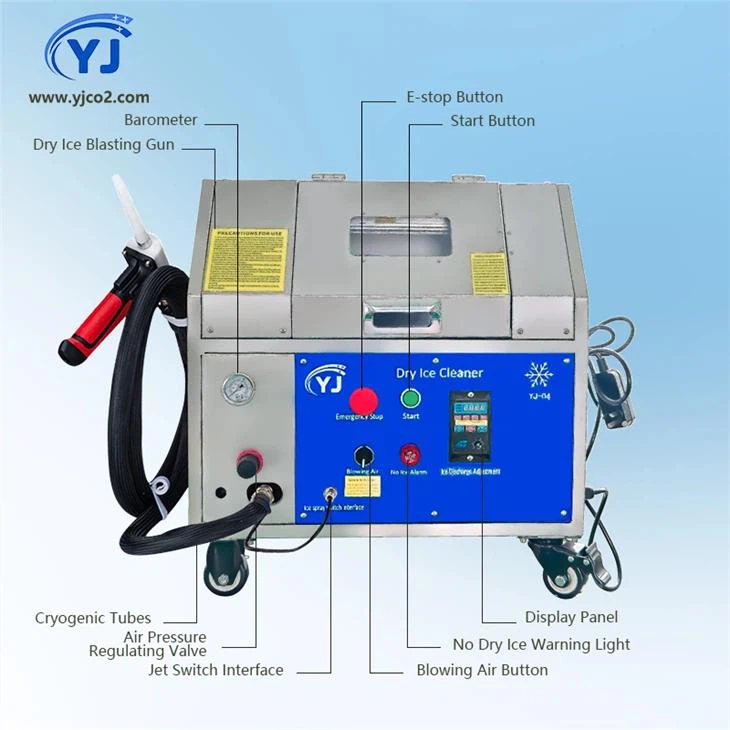
Troubleshooting Start-Up and Power Failures
Failure to start is one of the most common problems with dry ice cleaning machines, which can be caused by various factors. Such problems typically appear as no response after power-on or as indicator lights being on while the machine does not operate. A systematic check can quickly locate the fault and restore operation.
- Power connection problems are the primary cause of startup failure. Begin by checking the basics: confirm that the power outlet is live (test it with another device); check whether the power cable is intact without breaks or wear. Internal cable breaks may not be visible and require continuity testing. Ensure the power switch is in the "ON" position and making good contact. Statistics show that about 30% of so-called "equipment failures" are actually simple power issues.
- Voltage stability is equally important. Dry ice cleaning machines usually require stable working voltage. Low voltage may prevent startup, while high voltage may damage electronic components. Use a multimeter to measure the actual output voltage and ensure it falls within the rated range (typically 220V ±10%). Large industrial equipment switching on/off may cause fluctuations, so installing a voltage stabilizer is recommended where the supply is unstable.
- Blown fuses are another common obstacle. The power module usually has protective fuses that blow when overcurrent occurs. Open the module casing to check the fuse, and if it is blown, replace it with one of the same specification before retrying. If the new fuse blows again, there may be deeper electrical issues requiring inspection.
- Emergency stop switch status is often overlooked. For safety, dry ice cleaning machines are equipped with emergency stop buttons, which cut off power once pressed. Ensure all emergency stop switches are released (usually by rotating clockwise to pop out). Misuse of the emergency stop is a common cause of "faults," simple to fix but potentially costly due to downtime.
If the power is on and the indicator lights work but the motor does not run, the issue may lie in the motor system. Check whether the motor terminals are oxidized or loose. Measure winding resistance with a multimeter and compare with rated values to verify integrity. Check if the overload protection device has been triggered and reset if necessary. For three-phase motors, verify correct phase sequence, as missing a phase prevents startup.
Table: Quick Troubleshooting of Dry Ice Cleaning Machine Startup Failures
|
Phenomenon |
Possible Cause |
Check Method |
Solution |
|
No response, no indicator light |
Power not connected |
Check outlet, switch, wiring |
Restore power, fix disconnection |
|
Fuse blown |
Visual check or continuity test |
Replace fuse with same spec |
|
|
Emergency stop pressed |
Check switch status |
Release emergency stop |
|
|
Indicator light on, motor not running |
Motor wiring issue |
Check terminal connections |
Tighten/clean terminals |
|
Motor winding damaged |
Measure resistance |
Repair or replace motor |
|
|
Overload protection active |
Check protection status |
Reset overload protector |
For complex control system faults such as PLC errors or sensor failures, professional service is recommended. Modern dry ice cleaning machines usually have self-diagnosis functions, and interpreting error codes on the control panel can help locate the problem quickly.
Preventive maintenance reduces failures: regularly check power lines, clean electrical connections, and test the emergency stop function. Keep a maintenance log to record all faults and fixes, which helps identify recurring issues and implement long-term improvements. Monitoring power quality is also important, especially in regions with poor electrical infrastructure. Installing power conditioning equipment can significantly improve stability and extend service life.
Dry Ice Supply and Delivery Issues
The dry ice supply system is the core link for the normal operation of the cleaning machine, and its faults directly cause interruptions in the cleaning process. Supply issues usually appear as no ice output or uneven ice flow, which severely affects cleaning efficiency. Such faults may involve dry ice storage, delivery pipes, nozzles, and other components, requiring systematic inspection.
- Insufficient or poor-quality dry ice is the most basic yet commonly overlooked issue. Operators should first check the storage container to confirm whether the amount of dry ice is sufficient (recommended no less than 5KG per supply). Also check the physical condition of the dry ice-high-quality pellets should be uniform in size and free from clumping. If stored for too long or under improper conditions, clumping occurs, reducing flowability and transport efficiency. Storage containers should have good insulation to prevent accelerated sublimation. Note that different models of cleaning machines may require specific particle sizes; mismatched pellets can cause poor flow or reduced cleaning effectiveness.
- Nozzle blockage or wear is another common cause of abnormal ice output. As the final passage for dry ice spraying, the nozzle may become partially or fully blocked due to dirt accumulation or impurities in the pellets. Regularly inspect nozzle flow, especially for those with diameters of 0.8mm or smaller. Minor blockages can be cleared with special tools, but serious clogging or inner wall wear requires replacement. Different cleaning tasks require matching nozzle models; wrong selection leads to poor flow or suboptimal results. Keeping spare nozzles of common sizes is recommended to reduce downtime.
- Delivery pipe issues must not be ignored. Inspect all pipes for bends, flattening, or blockages. Excessively small bending radius restricts pellet flow, and long-term improper bending can cause permanent deformation. Loose pipe joints may cause air leakage or dry ice escape-check and tighten all connections. In cold environments, frost inside the pipes can increase resistance and must be cleaned. For longer pipelines, periodically check insulation quality, which is essential for stable delivery.
- Feeding mechanism failures require more professional repair. Dry ice cleaning machines typically use screw conveyors or pneumatic systems to deliver pellets from the hopper to the nozzle. Check whether the conveyor motor is functioning, whether the drive belt is slack or broken (replace if needed). For pneumatic systems, check if the compressed air pressure meets requirements-insufficient pressure prevents proper delivery. Mechanical components may wear with prolonged use, such as deformed screw blades or stuck bearings, requiring disassembly and replacement. Lack of lubrication is also a common cause-lubricate moving parts regularly as instructed.
- Incorrect mode settings are often overlooked human errors. Modern machines usually have multiple modes such as "ice output mode" or "air blow mode." Confirm the device is set to "ice output mode." Wrong settings may confuse system logic and prevent operation. Also, check if panel parameters are set correctly, as improper settings may stop or destabilize the supply system.
Table: Dry Ice Supply Troubleshooting Flow
|
Step |
Check Item |
Normal State |
Abnormal Handling |
|
1 |
Dry ice quantity |
≥5KG in hopper |
Add more dry ice |
|
2 |
Physical state |
Loose, no clumping |
Replace with qualified pellets |
|
3 |
Nozzle check |
Clear, no wear |
Clean or replace nozzle |
|
4 |
Pipe check |
No bends, tight joints |
Repair or replace pipe |
|
5 |
Mode setting |
"Ice output mode" |
Correct mode setting |
|
6 |
Mechanism test |
Smooth, no abnormal noise |
Professional repair |
Faulty low-temperature dry ice generators are systemic issues. Some high-end machines have built-in ice generators. If the generator fails, pellets cannot be produced. Check if the refrigeration system works properly, if the compressor runs smoothly, and whether the condenser is clean. Measure internal temperature to ensure it reaches -78.5°C or lower. Problems like refrigerant leakage or blocked expansion valves may occur-these require professional service.
Preventive maintenance is especially important for the supply system. Establish a routine plan:
- Daily: check dry ice storage conditions and quality.
- Weekly: clean pipes and nozzles.
- Monthly: check wear and lubrication of mechanical parts.
- Quarterly: calibrate sensors and control parameters.
Maintenance records should be detailed for spotting potential problems and predicting part lifespan. Operator training is equally important-correct habits reduce faults, such as clearing leftover pellets after use and avoiding long shutdowns in humid environments.
Compressed Air System Faults
The compressed air system is the power core of the dry ice cleaning machine, providing acceleration energy for pellets, and its performance directly affects cleaning results. Typical faults include abnormal pressure, unstable airflow, or no airflow at all, requiring timely inspection.
- Air source connection problems are the first step to check. Confirm that the compressor is powered on and running normally. Inspect hose connections for looseness or detachment. Quick couplings may wear over time, causing leaks or instability. Also confirm the air valve is fully open; some designs use lockable valves that must be unlocked. Hoses themselves may be cracked or bent, especially in mobile sections that suffer repeated folding.
- Insufficient air pressure is a common issue that reduces acceleration and cleaning performance. Check whether compressor output pressure meets the machine's requirement (usually 6–8 bar). Adjust compressor settings or repair as necessary. Faulty regulators may cause abnormal output-inspect the spring and valve core, clean or replace if stuck. Excessive pipeline length or undersized diameter also causes losses-keep pipelines short and no smaller than 8mm in diameter. Leaks may exist in joints or seals; apply soap solution to locate leaks.
- Compressed air quality problems are often overlooked but very harmful. Excess moisture or oil in air causes ice blockages or contamination. Check filters and drain condensate from the tank regularly. Upgrade with dryers or fine filters if necessary. In humid environments, refrigerated or adsorption dryers are recommended. Dust and particles may also clog pipes and nozzles, so replace intake filters regularly.
- Faulty pressure sensors cause misjudgment in the control system. Compare panel readings with mechanical gauges-large discrepancies indicate miscalibration or sensor failure. Check connections and wires for looseness. Diaphragms may be contaminated or damaged and need cleaning or replacement.
- Solenoid valve failure can block airflow. Over time, coils may burn out, valve cores stick, or seals degrade. When energized, the valve should vibrate slightly with a clicking sound; otherwise, the coil may be faulty. Disassemble and check for free valve core movement. Replace with reliable-quality valves to reduce frequent failures.
- System blockages often develop gradually. Impurities, water, or oil may accumulate in low spots, forming obstructions. Inspect all pipes, valves, and joints. Perform section isolation tests by closing outlets sequentially to find abnormal pressure drops. Regularly blow down the system after use to discharge residue.
Table: Compressed Air System Troubleshooting Guide
|
Symptom |
Possible Cause |
Diagnosis |
Solution |
|
No airflow |
Air source not connected |
Check compressor |
Start compressor, connect air |
|
Solenoid valve fault |
Test valve action |
Clean or replace valve |
|
|
Low pressure |
Compressor insufficient |
Measure output |
Repair or replace compressor |
|
System leakage |
Soap solution test |
Tighten or replace parts |
|
|
Pressure fluctuation |
Regulator fault |
Observe gauge |
Calibrate or replace regulator |
|
Small tank volume |
Compare usage vs tank |
Add larger tank |
|
|
Moist/oily air |
Filter failure |
Inspect filter |
Replace filter, upgrade system |
Preventive maintenance is key:
- Daily: drain condensate from tanks.
- Weekly: check pressure gauge accuracy.
- Monthly: clean/replace filters.
- Quarterly: inspect solenoids and seals.
Record details of each maintenance to track degradation. Compressors should also be serviced per manufacturer's schedule-replace oil and filters to prevent secondary failures.
For complex issues like internal compressor leaks or software faults, seek professional repair. Investing in high-quality components reduces downtime and repair costs in the long run.
Control System and Sensor Faults
The control system is the "brain" of the dry ice cleaning machine, coordinating subsystems and ensuring safety. Its faults may cause total shutdown or functional abnormalities, usually complex in nature and requiring structured troubleshooting. Modern machines commonly use PLCs or microprocessors with multiple sensors for automation, which increases fault variety.
- No display or abnormal display on the control panel is the most visible symptom. Check if control power is normal, including transformer output and fuses. Panel wiring may loosen due to vibration-ensure all connectors are secure. If the screen displays incorrectly or incompletely, the display itself or the main board may be faulty. A simple restart sometimes clears temporary software errors. In humid conditions, condensation may short-circuit boards-check for oxidation or corrosion.
- No response to operator input affects usability. Buttons or touchscreens may wear with use-inspect their physical state. Communication between the panel and controller may be interrupted due to damaged lines or oxidized connectors. The machine may also be in a locked state (maintenance or safety mode)-reset as per manual instructions. Software crashes are more serious, often requiring program reloads or firmware updates, usually by manufacturer support.
- Sensor faults cause incorrect data input, leading to wrong decisions. Machines are usually equipped with pressure, temperature, and position sensors. Use I/O monitoring functions to check real-time status and compare with normal ranges. Sensors may fail due to contamination, aging, or damage (e.g., punctured pressure diaphragms, deteriorated insulation of temperature probes). Improper installation also causes errors, such as a temperature probe placed too close to a heat source.
- Program logic errors are hidden but significant. PLC or processor programs may malfunction due to electromagnetic interference, memory errors, or sudden power loss. Symptoms include out-of-sequence actions, unnecessary safety triggers, or parameter resets. Restoring factory settings may help but erases custom parameters. Incompatibility between software versions may also cause instability.
Conclusion
Dry ice cleaning machines are powerful, eco-friendly cleaning tools, but their reliability depends on stable operation of multiple subsystems. Common problems include startup/power faults, dry ice supply issues, compressed air failures, and control system malfunctions.
Through systematic troubleshooting-starting from the power supply, then checking ice supply, air system, and finally control electronics-most problems can be resolved quickly. With regular preventive maintenance, operators can minimize downtime, reduce repair costs, and ensure long-term efficiency of their equipment.