


Dry ice-the solid form of carbon dioxide-plays a critical role in modern industry, from dry ice blasting and food preservation to medical cold chains and stage effects. Because it sublimates so readily, users often ask a common question: How long do dry ice pellets actually last?
The answer isn't simple. The lifespan of dry ice pellets depends on temperature, storage method, pellet size, and how they're used. To understand a more precise answer, in this guide, we will explore the scientific principles behind the sublimation of dry ice pellets and the estimation of preservation time in different situations, helping you to understand the specific preservation time of dry ice and reduce waste at the same time.

What Is Dry Ice and Why Does It "Disappear"?
Dry ice is the solid form of carbon dioxide (CO₂). Unlike regular water ice, it doesn't melt into a liquid - instead, it sublimates directly from a solid into a gas at –78.5°C (–109.3°F).
Sublimation means that CO₂ molecules in the crystal lattice absorb enough energy to break free and enter the gaseous state without passing through a liquid phase. During this process, dry ice absorbs about 573 kJ/kg of heat, making it an exceptionally powerful cooling agent.
When exposed to room temperature, dry ice begins to sublimate immediately, producing the familiar white fog - which is not the dry ice itself, but condensed water vapor from the surrounding air.
This constant phase change explains why dry ice "disappears" over time, even when stored in insulated containers. In open air at around 25°C, dry ice typically evaporates at a rate of 2–4.5 kg (5–10 lbs) per hour, and pellets sublimate even faster due to their larger surface area-to-volume ratio.
Key Factors Affecting How Long Dry Ice Pellets Last
The duration of dry ice pellets varies depending on several interrelated factors. Understanding them helps you plan usage and minimize loss.
1. Ambient Temperature
Temperature is the single most critical factor.
- At 25°C (77°F), 500 g of dry ice pellets last about 30 minutes.
- At 30°C (86°F) or higher, the same amount may vanish in under 15 minutes.
- In a cooler 18°C (64°F) room, pellets may last 2–3 hours.
- Under extreme cold (below –50°C in specialized freezers), pellets can be preserved for 5–10 days.
The larger the temperature difference between the environment and dry ice (–78.5°C), the faster the heat transfer and sublimation.
2. Storage Container
Insulation quality dramatically affects sublimation rate.
- In open air: 250–400 g/hour loss rate.
- In a foam cooler: only 100–150 g/hour.
- In a professional insulated transport box: 5 lbs of dry ice can maintain –50°C to –70°C for 3–8 days.
Tight seals help too - simply taping cooler gaps can triple storage time from 24 to 72 hours.
3. Pellet Size and Shape
Pellet size influences longevity.
- Small pellets (3mm) sublimate faster than large chunks due to their greater surface area.
- Pellets typically evaporate 20–30% faster than solid blocks.
While blocks suit long-term cooling, pellets excel in quick refrigeration or dry ice blasting due to their rapid cooling efficiency.
4. Humidity and Airflow
High humidity accelerates sublimation because condensed moisture transfers heat to the dry ice surface. Conversely, extremely dry air may slightly slow sublimation - though data varies across environments.
5. Usage Method
Open exposure and frequent container opening both shorten lifespan. Using dry ice with hot water (for fog effects) produces intense vapor but lasts only 5–10 minutes.
Estimated Duration for 500g of Dry Ice Pellets
|
Storage Condition |
Ambient Temperature |
Approximate Duration |
|
Open air |
25°C |
~30 min |
|
Open air |
>30°C |
<15 min |
|
Foam cooler |
25°C |
2–3 hrs |
|
Professional freezer |
–50°C |
5–10 days |
|
With hot water |
25°C |
5–10 min |
Typical Duration in Real-World Applications
Different industries use dry ice pellets under varying conditions. Below are realistic examples to guide expectations.
Stage Fog Effects
At ~25°C, 500g (1 lb) of dry ice creates fog for 3–5 hours, though exposure method changes results:
- Direct air exposure: ~2 hours
- Using warm water: dense smoke but only 5–10 minutes
Food Preservation & Cold Chain
In foam coolers at 25°C:
- 5 lbs of dry ice maintains –50°C to –70°C for 3 days
- In insulated transport boxes: up to 8 days
- For standard food boxes: 24–48 hours
Scientific & Medical Use
- Laboratory samples stored with dry ice in specialized freezers stay frozen for 5–10 days.
- 1 L of active reagent with 2 lbs of dry ice can remain stable for 5+ days.
Open Displays or Exhibitions
In fully open air, 500g pellets last only 15–30 minutes at room temperature.
Frequent replacement or batch use is required.
|
Application |
Storage/Use Type |
Environment |
Duration |
|
Stage fog |
Open container |
25°C |
2–3 hrs |
|
Stage fog + hot water |
Exposed |
25°C |
5–10 min |
|
Food transport |
Foam box |
25°C |
24–48 hrs |
|
Lab storage |
Freezer |
–50°C |
5–10 days |
|
Display effect |
Open tray |
25°C |
15–30 min |
For long-term or large-scale use, on-site pellet production using a dry ice pelletizer is more cost-efficient and ensures freshness.
How to Extend the Lifespan of Dry Ice Pellets
Proper storage can multiply dry ice duration by several times. Below are proven professional methods.
1. Use Insulated Containers
- Foam coolers reduce loss by 60–70%.
- Professional transport boxes cut waste by up to 80%.
- Thick walls (≥2.5 cm) and taped seams can triple lifespan.
2. Store in Cool, Shaded Areas
Reducing room temperature from 25°C to 18°C lowers sublimation by 40–50%.
Keep containers in shaded, ventilated spaces; avoid direct sunlight.
3. Layered Packaging
For mixed applications, layer large blocks at the bottom and pellets on top.
This structure balances fast cooling and long retention, extending total duration by ~30%.
4. Minimize Container Opening
Each opening raises internal temperature by 10–15°C, accelerating sublimation.
Plan retrieval in batches or use a dual-box setup for frequent access.
5. Use Professional Storage Equipment
Commercial-grade dry ice freezers feature vacuum insulation and CO₂ monitoring, keeping temperatures below –70°C for up to 10 days.
|
Storage Method |
Difficulty |
Cost |
Effectiveness |
|
Foam cooler |
Easy |
Low |
2–3× longer |
|
Taped cooler seams |
Very easy |
Minimal |
1.5× longer |
|
Professional freezer |
Complex |
High |
5–10× longer |
|
Layered packaging |
Medium |
Moderate |
1.3× longer |
|
Temperature control |
Medium |
Moderate |
2× longer |
Safety Tips When Handling Dry Ice
Dry ice's extreme cold and sublimation properties bring safety challenges. Follow these precautions carefully.
1. Avoid Direct Contact
Dry ice is –78.5°C; touching it causes instant frostbite.
Always use insulated tongs or thick cryogenic gloves. Never use cotton or plastic gloves.
2. Ensure Proper Ventilation
CO₂ gas from sublimation displaces oxygen, posing suffocation risks.
Avoid using or storing large amounts of dry ice in closed cars, rooms, or freezers.
Always ensure good ventilation or active exhaust fans, especially in labs or shipping areas.
3. Never Seal Dry Ice in Airtight Containers
Dry ice expands nearly 800× in volume when turning into gas, creating explosion risks.
- Don't store in refrigerators or sealed bottles.
- Use foam boxes with small ventilation gaps and leave 20% space for expansion.
Important: Never store dry ice in household freezers. The internal pressure and temperature difference may damage the compressor or cause door explosions.
Conclusion
Dry ice pellets typically last from 15 minutes to 10 days, depending on temperature, storage, and pellet size. Understanding the sublimation process and applying proper storage techniques can dramatically extend lifespan and efficiency.
For industrial users, on-site dry ice production is the best solution - ensuring fresh supply, reduced waste, and stable quality.

Explore our YJCO2 Dry Ice Pelletizer Series
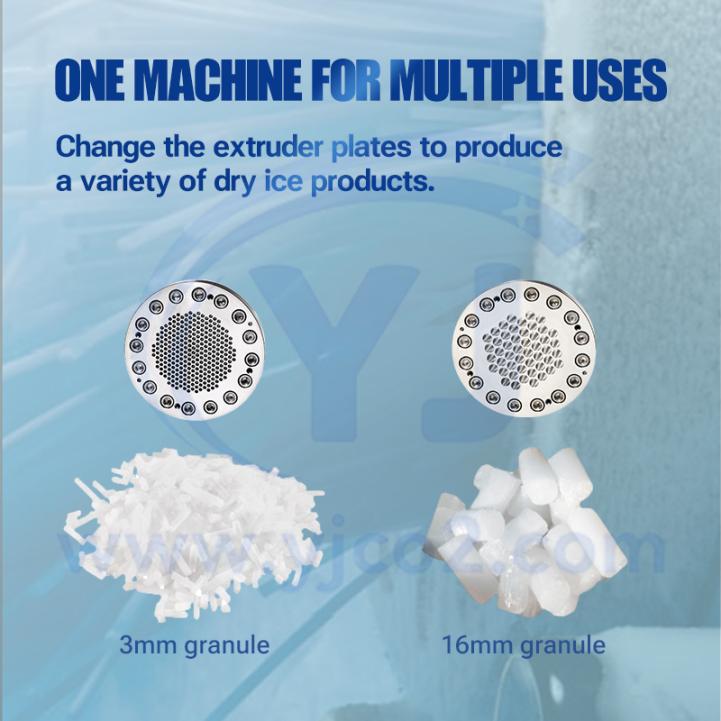
The YJ.GB series dry ice pelletizer features a compact design, small footprint, and user-friendly operation, equipped with a PLC automatic control system. The machine supports extrusion dies with apertures of 3mm, 6mm, 9mm, 16mm, and 19mm. By simply replacing the die holder, it can flexibly produce dry ice pellets of various sizes. The pellets produced are uniform in density and high in yield, while the optimized feeding structure ensures stable and reliable material supply.
Contact us now to learn about our advanced Dry Ice Pelletizer at a great price.
